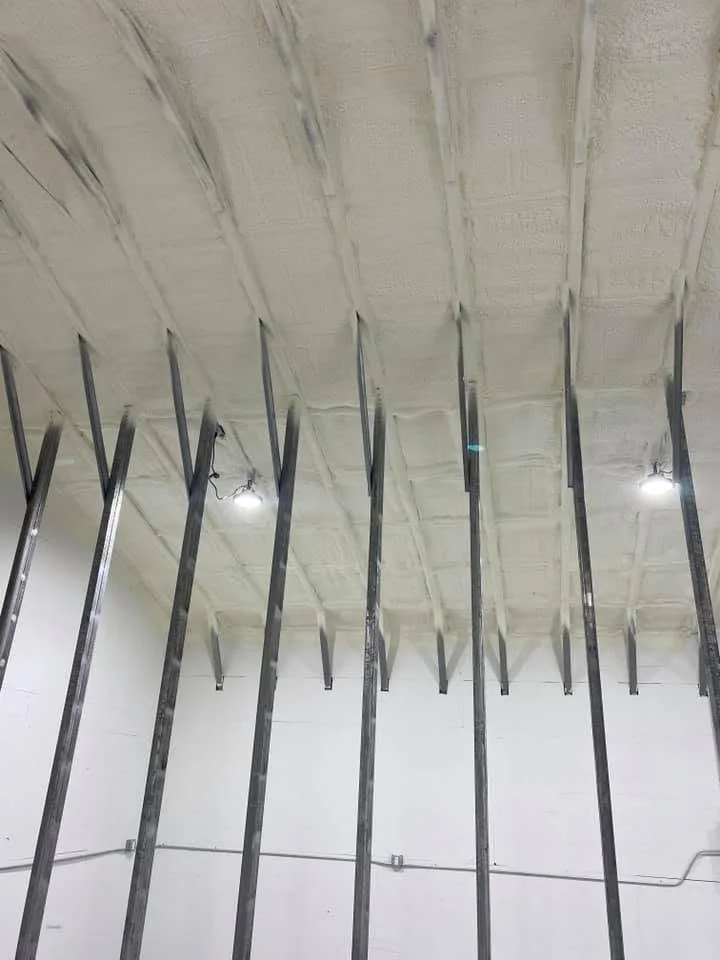
Is Spray Foam Insulation the Best Choice for Metal Buildings?
Skeeter Aimone
August 15th, 2026
Spray foam insulation is the strongest overall option for metal buildings in most climates and use cases, but “best” depends on your climate zone, budget, building purpose, and moisture conditions. Two main types of spray foam exist: open-cell and closed-cell, and each serves different roles in metal building construction. Open-cell foam delivers R-3.6 per inch at a lower material cost and is highly effective for sound dampening, while closed-cell foam delivers R-6 to R-6.5 per inch, acts as a vapor retarder, and adds structural rigidity. When combined with proper air sealing, commercial spray foam solutions can address the three biggest problems that plague uninsulated metal buildings: extreme temperature transfer, air infiltration through panel seams, and condensation-driven moisture damage.
TL;DR
Spray foam combines air sealing and insulation into a single application, something fiberglass batts and blown-in products cannot do as effectively.
The U.S. Department of Energy’s Building America program confirms that both open-cell (R-3.6/inch) and closed-cell (R-6/inch) spray polyurethane foams are “excellent at air-sealing,” a factor directly tied to energy savings of up to 20% on heating and cooling costs when sealing and insulating are combined.
Closed-cell spray foam doubles as a vapor retarder at typical thicknesses, making it the preferred choice for metal buildings in cold climates where condensation risk is highest.
Metal buildings are especially prone to condensation because the metal skin conducts heat rapidly, dropping surface temperatures below the dew point. Continuous insulation applied directly to the metal panels or framing interrupts that thermal bridge.
Open-cell foam absorbs and holds water, which makes it unsuitable for below-grade or flood-prone applications but acceptable for interior wall cavities in dry and mixed climates with proper vapor control.
The EPA’s ENERGY STAR program estimates that homeowners and building owners can save up to 20% on heating and cooling costs, or about 10% on total annual energy bills, through sealing and insulating their building envelope.
For metal buildings, the right insulation choice balances thermal performance, moisture control, structural support, and fire code compliance.
Why Metal Buildings Need Better Insulation
Metal buildings present unique thermal challenges that traditional framing does not. Steel conducts heat roughly 400 times faster than wood, which means every steel framing member, purlin, and girt becomes a thermal bridge, channeling heat directly through the wall and roof assemblies. A study by Building Science Corporation notes that steel stud framed walls with cavity insulation alone provide overall wall R-values of only R-5 to R-7, even when R-19 batts fill the cavities, because so much heat bypasses the insulation through the studs themselves.
Beyond thermal bridging, metal buildings suffer from extensive air infiltration. The panel systems, screw holes, ridge caps, eave trim, and door and window openings create countless gaps where conditioned air escapes and unconditioned air enters. According to the U.S. Environmental Protection Agency, sealing and insulating the building envelope is “often the most cost-effective way to improve energy efficiency and comfort.”
Then there is condensation. When warm, humid interior air contacts a cold metal surface, moisture condenses on the panel. Over time, this causes rust, corrosion, degraded fasteners, mold growth, and soaked insulation that loses its effectiveness. Building Science Corporation research shows that continuous exterior insulation keeps sheathing and panel surfaces above the interior dew point, effectively preventing condensation from air leakage. Spray foam applied directly to the interior metal skin or to framing members addresses both the air leakage path and the thermal bridge simultaneously.
Open Cell vs. Closed Cell Spray Foam for Metal Buildings
Understanding the differences between these two products is essential for selecting the right solution. The DOE Building America program, which published a detailed comparison guideline, notes that the two products are “not interchangeable in all applications.”
Property
Open-Cell (Half-Pound)
Closed-Cell (Two-Pound)
R-Value per Inch
R-3.6
R-6 to R-6.5
Density
0.5 lb/cubic foot
2.0 lb/cubic foot
Air Permeance
Air-impermeable at typical thicknesses
Air-impermeable
Vapor Permeance
5 to 10 perms at 5 inches (vapor permeable)
Less than 1 perm at 2 inches (vapor retarder)
Water Absorption
Absorbs and holds liquid water
Hydrophobic, does not absorb water
Expansion Ratio
Up to 150x original volume
35 to 50x original volume
Structural Benefit
Minimal
Adds racking strength to walls
Sound Damping
Superior (STC rating 37 in 2×4 wall)
Good (STC 23 in 2×4 wall)
Below-Grade Use
Not acceptable
Preferred
For most metal building projects, closed-cell foam offers the better overall package. Its higher R-value per inch means thinner applications achieve the same thermal resistance, which matters in metal buildings where cavity depth is often limited by the profile of the standing seam or the spacing between purlins. Its vapor-retarding properties eliminate the need for a separate vapor barrier in most assemblies, simplifying construction and reducing the chance of installation errors that lead to moisture problems.
How Spray Foam Solves the Condensation Problem
Condensation is the single most damaging issue in metal buildings, and spray foam is one of the few insulation materials that directly addresses its root causes. As Building Science Corporation explains, cold-weather condensation is primarily caused by outward air leakage carrying moisture to cold surfaces. If the interior surface of the exterior sheathing or metal panel drops below the dew point temperature of the interior air, condensation forms.
Spray foam tackles this problem on two fronts. First, it acts as an air barrier, sealing the gaps, seams, and penetrations where moisture-laden air would otherwise reach the cold metal. The DOE Building America program confirms both open- and closed-cell SPF are “excellent at air-sealing, a once overlooked, but critical aspect of insulated assemblies.” Second, when applied to the interior face of the metal panels or as continuous insulation over the framing, commercial spray foam insulation raises the temperature of the metal surface above the dew point, preventing condensation from forming even if some air leakage occurs.
Closed-cell spray foam is particularly effective because it is both an air barrier and a vapor retarder in a single layer. In cold climates, the DOE guideline recommends a minimum of 1.5 inches of closed-cell foam for hybrid wall systems to keep the interior surface of the foam above the dew point. In climates above 6,000 heating degree days, that minimum increases to 2 inches.
Comparison: Spray Foam vs. Other Metal Building Insulation Options
Insulation Type
R-Value per Inch
Air Sealing
Vapor Control
Best Metal Building Application
Closed Cell Spray Foam
R-6 to R-6.5
Excellent
Built-in vapor retarder
Walls, roofs, band joists, conditioned metal buildings
Open Cell Spray Foam
R-3.6
Excellent
Vapor permeable
Interior walls in dry climates, sound-dampening applications
Fiberglass Batts
R-3.1 to R-3.8
Poor
Requires separate vapor barrier
Budget projects with good air sealing already in place
Rigid Foam Board
R-3.8 to R-6.5
Varies by installation
Varies by type
Continuous exterior insulation over metal framing
Reflective/Bubble Insulation
R-1 to R-5.6 (varies)
None
None
Supplemental radiant barrier only, not a primary insulation
The U.S. Department of Energy Guide to Home Insulation lists sprayed or foamed-in-place insulation as the category that “allows you to fill even the smallest cavities,” a benefit that is especially relevant in metal buildings where irregular framing, corrugated panel profiles, and complex geometries make fitting batt insulation difficult.
Recommendations by Building Type
Conditioned workshops and living spaces: Closed-cell spray foam applied to the full wall and roof assembly provides the best combination of insulation, air sealing, and moisture control. According to BuildUsingSteel.org, continuous insulation systems are critical for reducing thermal bridging through steel framing members. The vapor-retarding properties of closed-cell foam eliminate the risk of interstitial condensation, and the added structural rigidity can improve resistance to wind loading.
Storage buildings and unconditioned spaces: Open-cell spray foam may be sufficient if the primary goal is temperature moderation and sound control rather than strict climate control. The lower installed cost makes it practical for larger buildings where full closed-cell application would be prohibitively expensive.
Cold storage and high-humidity environments: Closed-cell spray foam is the clear choice. The DOE Building America program identifies hot-humid climates as the scenario where closed-cell foam is “preferred” for wall cavities due to its ability to serve as a redundant moisture control layer.
Below-grade or flood-prone metal buildings: Only closed-cell foam is acceptable. Open-cell foam absorbs and holds water, making it unsuitable for any application where direct water contact is possible.
Signs You Have Found the Right Insulation Approach
The installer explains both the thermal and moisture-control implications of the recommended foam type for your specific climate zone and building use.
You receive a clear breakdown of where each foam type will be applied and why, rather than a one-size-fits-all proposal.
The proposal addresses thermal bridging at metal framing members, not just cavity insulation between them.
Fire code compliance is discussed openly, including thermal barrier and ignition barrier requirements.
The contractor performs a pre-installation assessment of existing moisture issues, ventilation, and the building’s air-tightness needs rather than quoting insulation on square footage alone.
Get a Professional Assessment for Your Metal Building
Choosing the right spray foam insulation for your metal building requires a careful evaluation of your climate, building design, intended use, and moisture risk. Our team at High Country Solutions provides detailed assessments and professional spray foam installation tailored to metal building structures. We help you determine whether open cell, closed cell, or a hybrid approach delivers the best performance for your situation.
Call us at (307) 248-9063 or email [email protected] to discuss your metal building insulation project with our experienced team.
Frequently Asked Questions
Can spray foam be applied directly to the interior of metal roofing panels?
Yes, closed-cell spray foam is commonly applied directly to the underside of metal roof panels. The DOE Building America program identifies closed-cell spray foam as the preferred choice for sloped roof applications across all climates because it provides both high R-value per inch and built-in vapor retarder properties, eliminating the need for a separate vapor barrier under most metal roofing assemblies.
How thick should spray foam be in a metal building wall?
The required thickness depends on your climate zone and target R-value. Closed-cell foam at R-6 per inch achieves target insulation levels with thinner applications than open-cell at R-3.6 per inch. The DOE’s zip-code-based insulation calculator can help determine the right R-value target for your specific location.
Does spray foam prevent condensation in metal buildings?
Spray foam is one of the most effective solutions for preventing condensation in metal buildings because it acts as both an air barrier and thermal insulation. By sealing air leakage paths and keeping interior metal surface temperatures above the dew point, spray foam addresses the two primary mechanisms that cause condensation.
Is closed-cell spray foam worth the extra cost over open-cell for metal buildings?
In most metal building applications, yes. Closed-cell foam provides higher R-value per inch, acts as a vapor retarder, adds structural strength, and resists water absorption. For metal buildings where moisture control and durability are top priorities, the performance advantages of closed-cell foam justify the higher material cost.
Can open cell spray foam cause moisture problems in metal buildings?
Open-cell foam is vapor permeable and can absorb and hold significant amounts of water. In humid climates or in buildings without proper interior vapor control, open cell foam can become saturated. The DOE Building America program recommends avoiding open-cell foam in below-grade applications and ensuring proper interior vapor retarders are in place for cold-climate wall assemblies.
U.S. Department of Energy – Guide to Home Insulation – DOE resource covering insulation types including sprayed and foamed-in-place products, R-value definitions, climate zone recommendations, and general cost and performance data for common insulation materials.
BuildUsingSteel.org – Energy Efficiency – American Iron and Steel Institute resource on steel building energy performance, including the role of continuous foam insulation systems in reducing thermal bridging through steel framing members and the impact of cool metal roofing on cooling energy loads.
I’m Skeeter Aimone, owner of High Country Solutions in Alpine, Wyoming, leading the company since 2019. I focus on quality installation, building science, and insulation solutions suited to harsh Wyoming and eastern Idaho conditions.