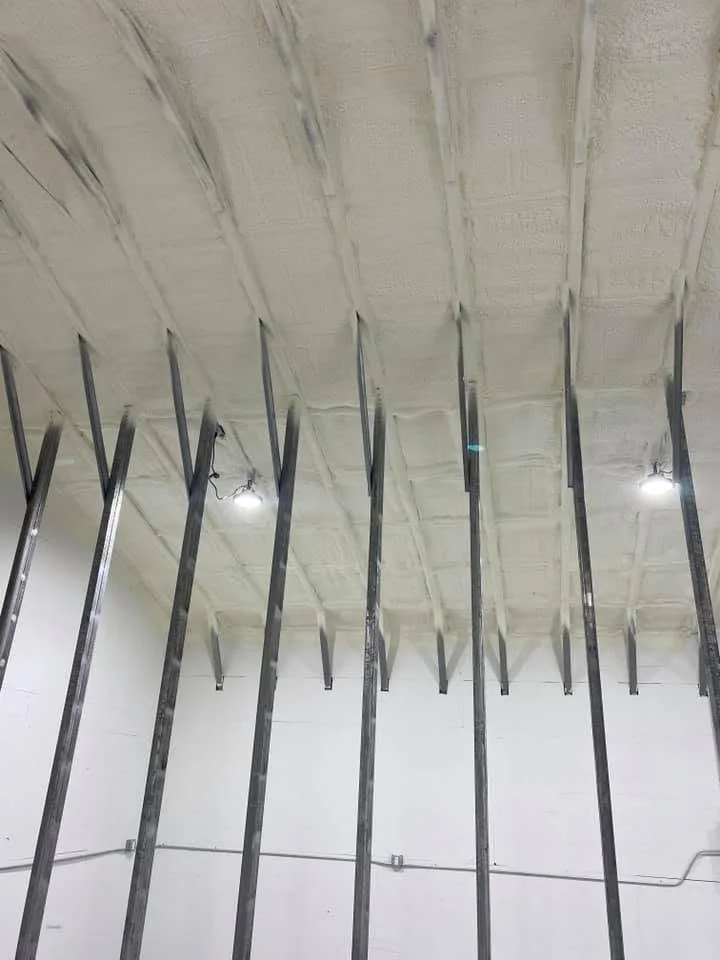
What Are the Benefits of Spray Foam Insulation in New Construction Homes?
Skeeter Aimone
July 15th, 2026
Spray foam insulation delivers a combination of air sealing, thermal resistance, and moisture control that traditional insulation materials simply cannot match as a single product. For builders and homeowners investing in new construction, spray polyurethane foam (SPF) serves as both insulation and an air barrier in one application, which means lower energy bills, better indoor comfort, and a tighter building envelope from day one. The material expands up to 30 to 60 times its liquid volume when applied, filling cracks, crevices, and gaps that fiberglass batts or blown-in cellulose would leave exposed. Two main types exist, open-cell and closed-cell foam, each suited to different areas of a build and different performance priorities. Choosing the right type depends on climate zone, budget, and new construction insulation planning when vapor control, structural reinforcement, or sound dampening are priorities.
TL;DR
Spray foam acts as both insulation and an air barrier in a single application, sealing gaps that traditional materials leave behind.
Closed-cell spray foam delivers an R-value of approximately R-5.1 to R-6.0 per inch, while open-cell foam offers roughly R-3.8 per inch.
Air leakage accounts for 25 to 40 percent of energy used for heating and cooling, and spray foam directly addresses this problem.
The 2021 IECC sets climate-zone-specific R-value requirements; spray foam can help new builds meet or exceed those benchmarks.
Closed-cell foam doubles as a vapor barrier and adds structural rigidity to wall assemblies when installed at the proper thickness.
Open-cell foam provides sound attenuation and is well suited for interior wall cavities where a vapor barrier is handled elsewhere.
New builds using spray foam insulation may qualify for federal tax credits tied to meeting the 2021 IECC energy code.
Proper curing and re-occupancy protocols are required for health and safety during installation.
How Spray Foam Insulation Works in New Construction
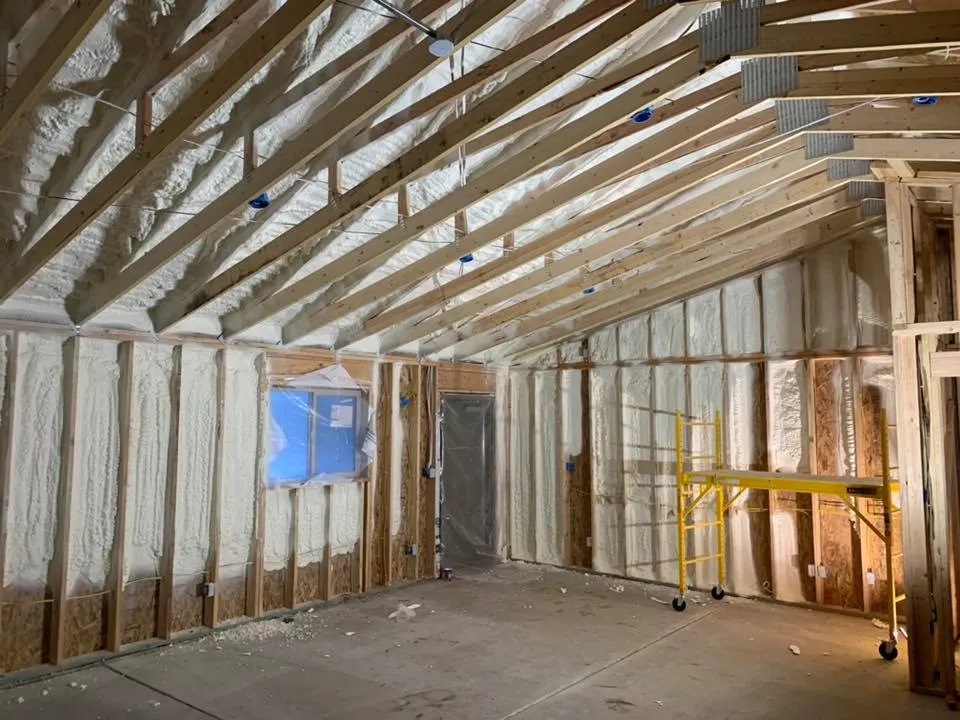
Spray foam insulation starts as a two-component liquid mixture containing isocyanates (side A) and polyol resin blended with catalysts, flame retardants, and blowing agents (side B). When sprayed through a heated gun, these components react chemically and expand into a continuous foam layer that conforms to every surface it contacts. According to the Spray Foam article on Wikipedia, the material can expand up to 30 to 60 times its original liquid volume, which is what allows it to fill voids, gaps, and irregular spaces that batt insulation cannot reach.
In new construction, this matters because framers leave dozens of penetrations for wiring, plumbing, and HVAC runs. Traditional insulation gets compressed, split, or simply bypassed at these points. Spray foam adheres to studs, sheathing, and framing members, creating a monolithic layer with no gaps. This addresses all three modes of heat transfer at once: conduction through materials, convection through air movement, and radiation through thermal emissions. As the Wikipedia Building Insulation entry explains, thermal insulation in buildings is a fundamental step toward achieving indoor comfort and reducing the energy demands of heating and cooling systems.
Open-Cell vs. Closed-Cell Spray Foam
Understanding the differences between the two primary spray foam types helps builders select the right material for each area of a new build.
Feature
Open-Cell Spray Foam (ocSPF)
Closed-Cell Spray Foam (ccSPF)
Density
Low density, approximately 0.5 lb per cubic foot
Medium density, approximately 2 lb per cubic foot
R-Value per Inch
Approximately R-3.8
Approximately R-5.1 to R-6.0
Cell Structure
Open cells filled with CO2, sponge-like texture
Sealed cells filled with low-conductivity gas
Vapor Barrier
Not a vapor barrier at typical thicknesses
Acts as both air and vapor barrier at 50mm+
Air Barrier
Yes, at 5.5 inches or more
Yes, at minimum installed thickness
Best Applications
Interior walls, sound dampening, wall cavities
Exterior walls, crawl spaces, foundations, roofs
Structural Benefit
Minimal
Adds shear strength and wall rigidity
Sound Reduction
Excellent sound absorption
Moderate sound reduction
Open-cell foam expands more during application, making it effective at sealing complex cavities and filling voids in interior partitions where sound control matters. Closed-cell foam, with its denser structure, resists moisture infiltration and adds measurable structural integrity to the assemblies it insulates.
Energy Efficiency and Air Sealing
The single largest performance advantage spray foam offers over conventional insulation is its ability to air seal while insulating. The U.S. Department of Energy, through ENERGY STAR and IECC guidance, notes that air leakage accounts for between 25 and 40 percent of the energy used for heating and cooling in residential buildings. Every gap around window rough openings, electrical boxes, plumbing penetrations, and rim joists is a pathway for conditioned air to escape.
Spray foam eliminates these pathways by expanding into and sealing them during application. This means the HVAC system in a new build can be sized smaller, runs less frequently, and maintains more consistent temperatures room to room. The DOE also notes that new construction meeting the 2021 International Energy Conservation Code requirements for insulation and air sealing may qualify homeowners for federal tax credits, adding a financial incentive when evaluating new construction insulation costs.
Buildings insulated with spray foam have been shown to insulate up to 50 percent better than structures using traditional insulation products, according to research cited by the U.S. Department of Energy. This is not because spray foam has dramatically higher R-values inch for inch, but because the real-world effective R-value of traditional insulation drops significantly when air moves through gaps the insulation cannot seal.
Moisture Control and Building Durability
Moisture management is one of the most overlooked aspects of new construction, and it is where spray foam delivers particularly strong benefits. As the Wikipedia Building Insulation reference documents, condensation and mold are responsible for a meaningful percentage of building damage. When warm, humid indoor air meets cold surfaces inside wall cavities or attics, condensation forms, creating conditions for mold growth and wood rot.
Closed-cell spray foam serves as a vapor barrier when installed at the manufacturer’s recommended minimum thickness, preventing moisture from migrating through wall assemblies. In crawl spaces and basements, closed-cell foam applied to rim joists and foundation walls blocks ground moisture and humid air from entering the conditioned space. This dual function of insulating and air-moisture sealing in one step is difficult to replicate with any combination of fiberglass, rigid board, and separate vapor barrier products.
Sound Control Benefits
Open-cell spray foam in particular offers strong acoustic dampening for new construction homes. The open-cell structure absorbs airborne sound transmissions through wall cavities, ceiling assemblies, and floor-ceiling systems. This makes spray foam a practical choice for interior partitions between bedrooms and living spaces, home theaters, or any room where noise reduction is a priority. Builders working on custom homes with open floor plans often use open-cell foam in select interior walls to create quieter, more private spaces without adding extra layers of drywall or sound-dampening board.
Health and Safety During Installation
While cured spray foam is considered inert and non-toxic, the application process requires careful attention to safety. The EPA’s archived guidance on spray polyurethane foam warns that isocyanates and other SPF chemicals in vapors and aerosols during and immediately after installation can cause asthma, lung damage, respiratory problems, and skin and eye irritation. The agency recommends that only trained applicators wearing appropriate personal protective equipment be present during installation, and that building occupants follow manufacturer re-occupancy guidelines, which typically range from 8 to 24 hours depending on the product type and thickness applied.
OSHA’s isocyanates safety page further documents that isocyanates are known skin and respiratory sensitizers, meaning repeated exposure without protection can lead to occupational asthma. In a new construction setting where spray foam is applied before drywall, HVAC systems, and finishes are in place, these risks are manageable when installers follow established safety protocols and allow proper curing time before other trades return to the work area.
Choosing the Right Insulation Strategy for Your Build
The decision matrix below helps builders and homeowners match insulation choices to their specific project priorities.
Project Priority
Recommended Approach
Key Notes
Maximum energy efficiency in cold climate
Closed-cell foam on walls, rim joists, and basement; open-cell in interior partitions
Meets or exceeds 2021 IECC R-value requirements for zones 5 through 8
Hot-humid climate new build
Closed-cell foam at roof deck, walls, and crawl spaces
Vapor barrier function prevents condensation from humid outdoor air
Sound control in open floor plan
Open-cell foam in select interior walls
Absorbs airborne noise between living areas and bedrooms
Budget-conscious new construction
Hybrid approach: closed-cell at problem areas (rim joists, cantilevers), open-cell or batts in standard wall cavities
Targets air sealing dollars where leaks cause the most energy loss
Net-zero or Passive House target
Full closed-cell envelope with continuous exterior insulation
Achieves air barrier continuity and thermal performance for high-performance certifications
Signs You Have Chosen the Right Spray Foam Installer
Working with a qualified installer is as important as choosing the right material. Watch for these indicators of a professional operation:
Clear explanation of product types and applications, including why they recommend open-cell versus closed-cell for specific areas of the build.
Willingness to share safety data sheets and curing protocols for the specific products they will use on your project.
References from recent new construction projects that you can verify, particularly homes with blower door test results demonstrating low air leakage.
Transparent pricing tied to measured square footage and thickness, with clear documentation of R-value targets per assembly.
Knowledge of local building code requirements, including fire barrier provisions and any jurisdiction-specific rules governing spray foam in occupied dwellings.
Get Started With High Country Solutions
Making the right insulation choice during new construction pays dividends for decades in lower energy costs, improved comfort, and a more durable home. High Country Solutions brings experienced installation teams and a deep understanding of spray foam products to every project we take on. Whether you are building a custom home or planning a larger residential development, our team can help you select the right foam type for each area of the build and ensure it is installed to meet or exceed current energy code requirements.
Reach us at [email protected] or call (307) 248-9063 to discuss your new construction insulation needs. We are ready to help you build a tighter, more efficient home from the ground up.
Frequently Asked Questions
Does spray foam insulation qualify for federal tax credits in new construction?
New builds that meet the 2021 International Energy Conservation Code insulation and air sealing requirements, which spray foam can help achieve, may be eligible for the federal Energy-Efficient Home Improvement Credit. Check current IRS guidelines for specific credit amounts and eligibility rules.
How long does spray foam take to cure before other trades can work in the space?
Curing times vary by product and thickness, but most manufacturers recommend 8 to 24 hours before unprotected workers or occupants re-enter the space. Your installer should provide specific re-occupancy guidance based on the products and conditions on your site.
Can spray foam insulation be used in all areas of a new home?
Both open-cell and closed-cell spray foam can be applied to walls, ceilings, attics, crawl spaces, rim joists, and foundations. The type selected for each area depends on whether the assembly needs a vapor barrier, sound control, structural reinforcement, or a specific R-value target.
Is spray foam safe after it has fully cured?
Once spray foam has fully cured, it is considered chemically inert and non-toxic. The EPA notes that properly applied and fully cured spray foam is relatively stable, though curing rates can be affected by temperature, humidity, and application technique.
How does spray foam compare to fiberglass batt insulation in energy performance?
Spray foam provides higher R-value per inch than fiberglass and, more importantly, serves as an air barrier that fiberglass cannot provide. The real-world performance advantage comes from eliminating the air leaks that reduce the effective R-value of traditional batt insulation by 25 to 40 percent.
Sources
Wikipedia – Building Insulation – Comprehensive reference on thermal insulation materials, energy savings, moisture management, and building code requirements for insulation across multiple countries.
Wikipedia – Spray Foam – Detailed overview of spray polyurethane foam types, R-values, air sealing properties, applications, and blowing agent history for building insulation.
OSHA – Isocyanates – Occupational Safety and Health Administration resource on the hazards of isocyanate exposure during spray foam application and other polyurethane manufacturing processes.
I’m Skeeter Aimone, owner of High Country Solutions in Alpine, Wyoming, leading the company since 2019. I focus on quality installation, building science, and insulation solutions suited to harsh Wyoming and eastern Idaho conditions.