What Makes Spray Foam Insulation Effective for Commercial Building Envelopes?
Skeeter Aimone
September 11th, 2026
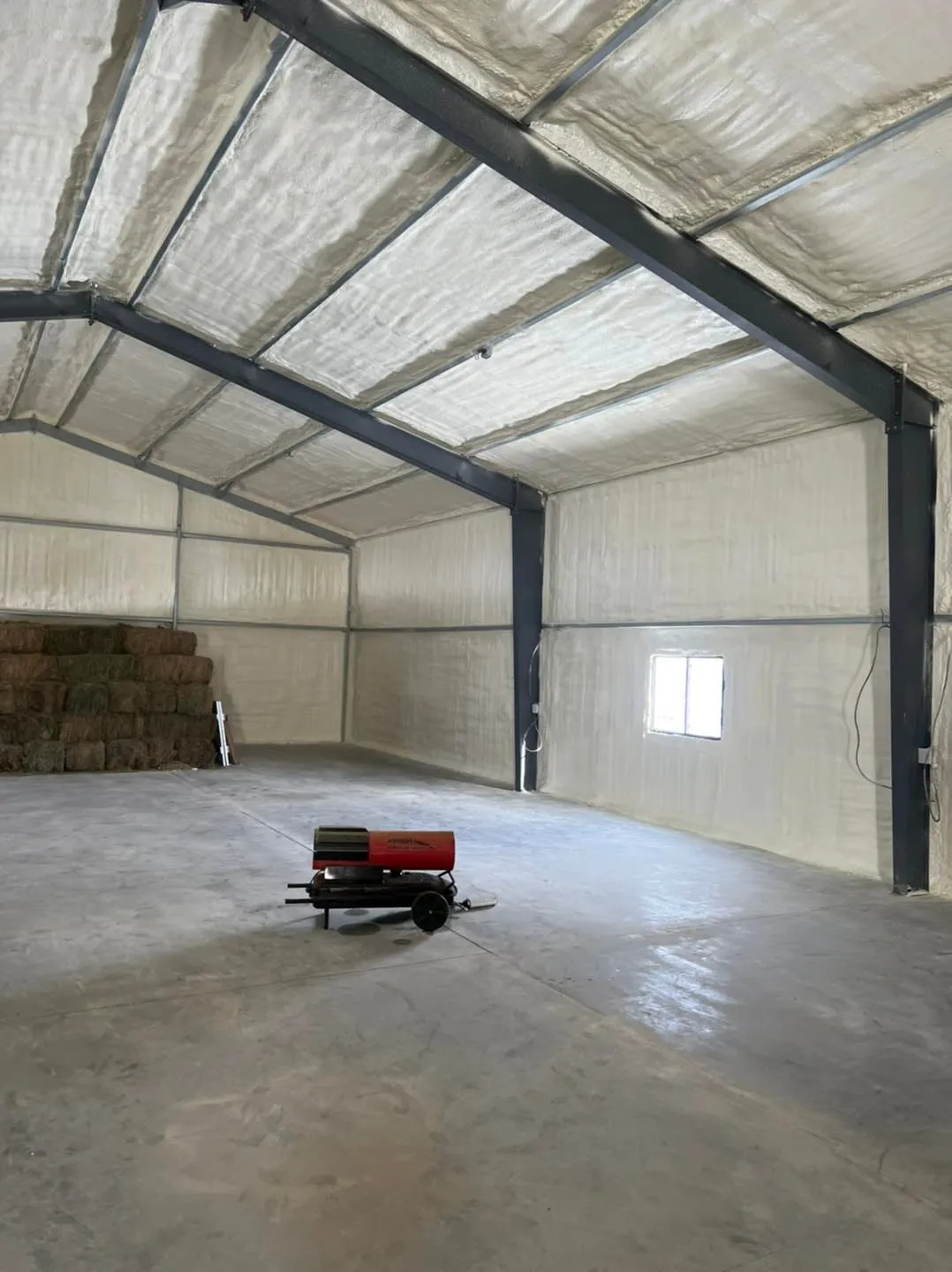
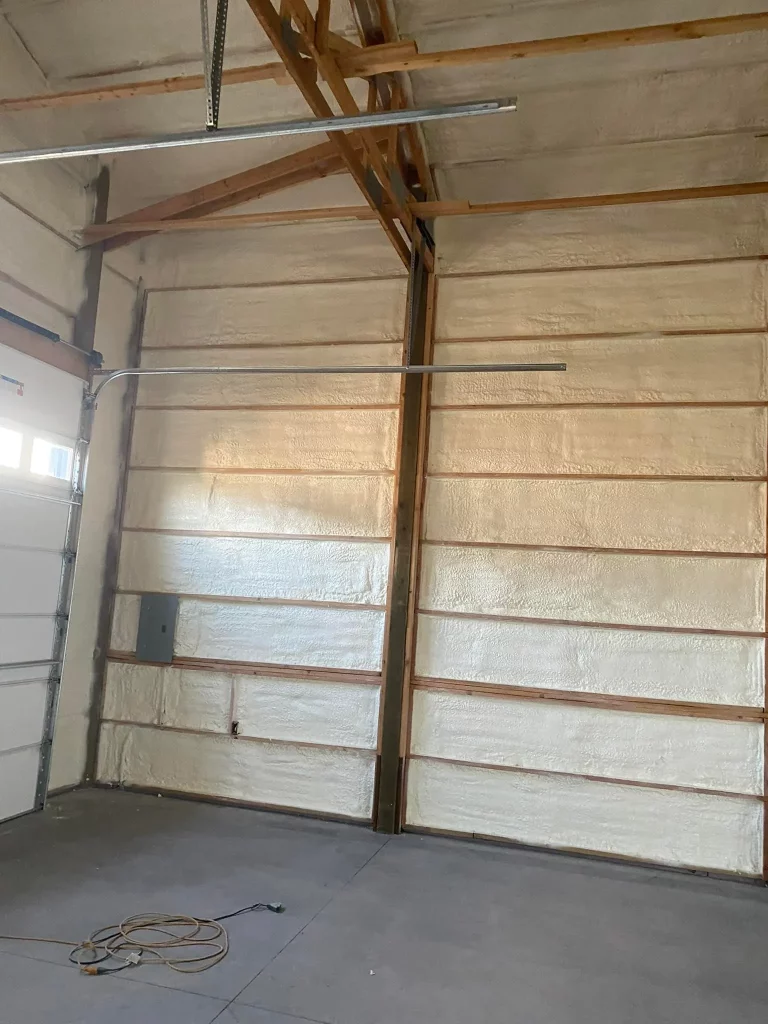
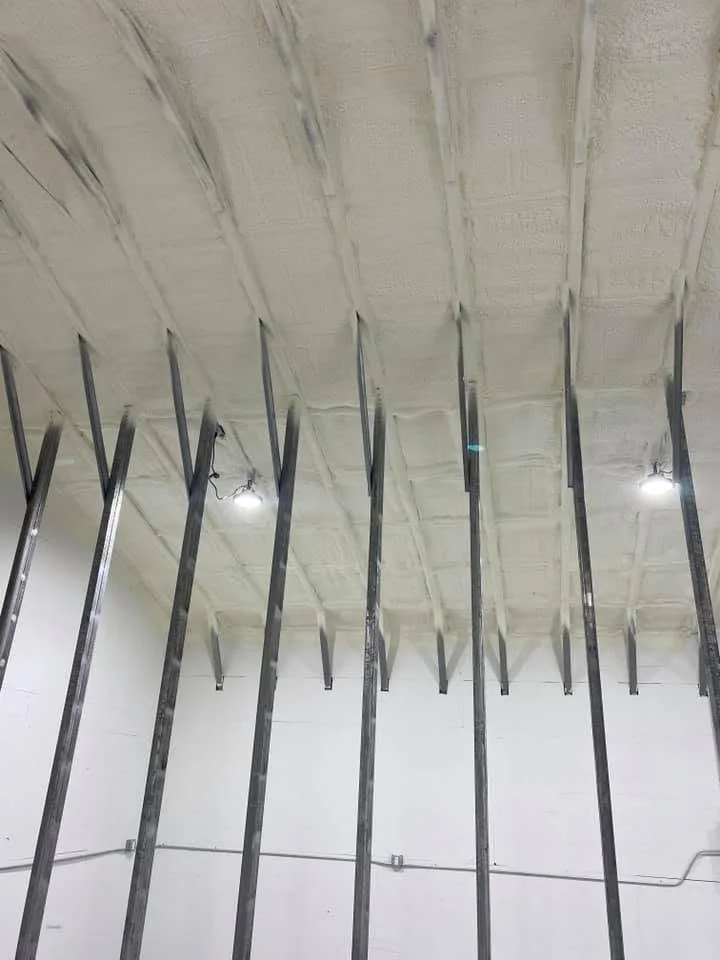
A commercial spray foam insulation guide explains why spray foam insulation earns its place in commercial building envelopes because it performs two jobs in a single application: it insulates and it air-seals. The material starts as a two-part liquid that expands up to 30 to 60 times its original volume, conforming to steel decking, masonry, and irregular framing to form a continuous thermal and air barrier layer. Depending on whether you choose open-cell or closed-cell foam, thermal performance ranges from roughly R-3.6 to R-6.5 per inch, and closed-cell products add vapor control plus structural rigidity. The right specification depends on your climate zone, building type, moisture exposure, and occupancy schedule, and the sections below break down exactly how each of those factors shapes performance.
TL;DR
Closed-cell spray foam delivers long-term thermal resistance of roughly R-5.1 to R-6 per inch, compared with about R-3 to R-4 for common fiberglass products, so it hits code targets in thinner wall and roof assemblies.
Open-cell foam, at roughly R-3.8 per inch, expands to fill large cavities and functions as an air barrier at 5.5 inches or more, making it a strong fit for interior partitions and sound control.
U.S. Department of Energy research indicates as much as 40 percent of a building’s energy can be lost through air infiltration, which spray foam directly addresses.
Convective loops inside poorly sealed wall assemblies can account for 10 to 20 percent of heat loss on their own, so air sealing matters as much as R-value.
Closed-cell foam applied at about 50 mm (2 inches) serves as both an air barrier and a vapor barrier in one pass, reducing material layers and trade coordination on commercial jobs.
Framing members create thermal bridges that cavity insulation alone cannot fix, which is why continuous, adhered coverage changes whole-assembly performance.
Installation quality decides outcomes: two-part chemistry, substrate temperature, and curing discipline separate high-performing envelopes from warranty claims.
Why Commercial Building Envelope Performance Starts With Air Control
The building envelope is the physical separator between conditioned and unconditioned space, and building science ranks its control functions, in order of importance, as rain control, air control, heat control, and vapor control (Wikipedia – Building Envelope). Most insulation products address only heat control. Spray foam addresses three of the four at once, which is why envelope designers keep specifying it for high-performance commercial work.
Air leakage deserves special attention on large commercial structures. Research cited in envelope science literature shows that convective loops within walls and ceilings alone can produce 10 to 20 percent of total heat loss (Wikipedia – Building Envelope). After installation, a commercial spray foam contractor can use blower door testing to quantify envelope tightness and infrared thermography to locate thermal bridging, insulation discontinuities, and remaining leakage paths that need correction. Foam gives you a measurable path to a tighter number.
Continuous Air Sealing: The Performance Multiplier
Department of Energy studies cited in insulation references estimate that up to 40 percent of a building’s energy is lost through air infiltration at walls, windows, and doorways (Wikipedia – Spray Foam). Batts and blankets leave bypasses and air pockets behind. Spray polyurethane foam expands while curing, fills bypasses, and bonds directly to substrates with virtually no air infiltration through the insulated layer.
Industry air barrier references explicitly recognize closed-cell, medium-density spray-applied polyurethane foam as an air barrier in its own right (Wikipedia – Air Barrier). Qualifying materials must show air permeance no greater than 0.02 L/(s·m²) at a 75 pascal pressure difference under ASTM E2178 testing. Because sprayed foam is field-applied and continuous, it also handles the transitions, penetrations, and assembly junctions where sheet goods and tapes most often fail on commercial projects.
Open-Cell vs Closed-Cell Spray Foam for Commercial Assemblies
Property
Open-Cell (Half-Pound)
Closed-Cell (Two-Pound)
R-value per inch
~R-3.6 to R-3.8
~R-5.1 to R-6.5
Structure
Soft, sponge-like, vapor-permeable
Rigid, dense, water-resisting
Air barrier
Yes, at 5.5 inches or more
Yes, at roughly 2 inches (50 mm)
Vapor barrier
No
Yes, at a minimum 50 mm thickness
Added benefits
Sound absorption, fast cavity fill
Structural reinforcement, moisture resistance
Typical commercial use
Interior walls, partitions, plenums
Roof decks, exterior walls, metal buildings, cold storage
Open-cell SPF expands during application to fill cracks, crevices, and voids while adhering to irregular surfaces, and it is valued indoors for sound reduction because it blocks and absorbs air leakage paths (Wikipedia – Spray Foam). Closed-cell SPF is the workhorse for exterior exposure: when installed at the required minimum thickness of 50 mm, it functions as both a vapor barrier and an air barrier, and its dense cell structure resists liquid water (Wikipedia – Spray Foam).
R-Value Density and Thermal Bridging in Real Assemblies
Reference tables list closed-cell polyurethane spray foam at R-5.5 to R-6.5 per inch, open-cell polyurethane at about R-3.6, and fiberglass batts at R-3.1 to R-4.3 per inch (Wikipedia – R-value (Insulation)). But whole-assembly performance is what pays the utility bill. Studs and windows create parallel heat conduction paths that cavity insulation does not touch, so doubling the R-value between framing members yields far less than a 50 percent reduction in heat loss (Wikipedia – R-value (Insulation)).
Spray foam helps in two ways here. It adheres to framing faces and sheathing, eliminating the gaps, compression, and voids that degrade batt performance, and its high R-value per inch lets designers add real thermal resistance without deepening wall or roof assemblies, a real advantage when leasable floor area is fixed.
Moisture Control, Condensation, and Structural Benefits
Closed-cell foam seals cracks and construction joints, contributing to both airtightness and structural integrity, and it helps prevent condensation on walls and windows by keeping warm, moist interior air away from cold surfaces (Wikipedia – Spray Foam). That condensation control lowers the risk of mold, mildew, and wood rot inside the assembly. For roof decks and metal buildings, the added racking strength of rigid closed-cell foam is a practical bonus that batt products cannot offer.
Recommended Approach by Building Type
Building Type
Recommended Approach
Why It Works
Metal warehouses and shops
Closed-cell on roof deck and walls
Adheres to corrugated steel and seals fastener patterns
Cold storage and food processing
Full-depth closed-cell assembly
Vapor control prevents condensation and ice in the envelope
Office and retail interiors
Open-cell in partitions and plenums
Fast cavity fill plus acoustical separation between spaces
Tilt-up and masonry retrofits
Closed-cell on interior mass walls
High R per inch without sacrificing floor area
Occupied building upgrades
Phased scheduling with re-occupancy plan
Controls curing fumes and ventilation for occupants
What Separates a Strong Installation From a Failed One
Spray polyurethane foam is a chemical product created when two parts, side A and side B, react at the spray gun tip, and that reaction is exothermic, generating heat as the foam rises (U.S. EPA – Spray Polyurethane Foam). Ratio errors, cold substrates, or moisture during application can cause shrinkage, voids, or off-spec density. The product is also only considered inert after it has cured, and it emits gas during the curing window, so occupant protection, ventilation, and re-occupancy timing are non-negotiable parts of a professional scope. Foam generally requires an approved thermal barrier, such as gypsum board, where codes demand it on interior exposures.
Signs You Have Found the Right Spray Foam Partner
Whole-assembly thinking: they discuss R-value, air barrier continuity, and vapor drive together, not just product thickness.
Verification offered up front: blower door testing and infrared scanning are proposed as part of the scope, not as an upsell.
Transparent data: they show long-term aged thermal resistance values, not just initial laboratory numbers.
Clear safety protocol: a written re-occupancy and ventilation timeline protects your people and your warranty.
Climate-specific strategy: the vapor plan changes with your zone instead of defaulting to one product for every wall.
Detailed written scope: thickness, density, yield, fire protection requirements, and testing are all in the proposal.
Get a Building Envelope Evaluation From Our Team
High Country Solutions specializes in spray foam insulation and building envelope upgrades for commercial properties, and our team designs every project around the assembly, climate, and occupancy realities of your building rather than a one-size-fits-all spec. Reach us at [email protected] or call (307) 248-9063 to talk through your project.
Every dollar of energy performance lives or dies at the envelope, so let our team help you seal it right the first time.
Frequently Asked Questions About Commercial Spray Foam
Is closed-cell spray foam worth it for commercial buildings?
Yes, where moisture exposure, limited wall depth, or structural reinforcement matter, closed-cell delivers the highest R-value per inch and doubles as an air and vapor barrier. Open-cell is often the smarter pick for interior partitions where sound control and full cavity fill are the goals.
How thick does spray foam need to be to act as an air barrier?
Closed-cell foam functions as an air barrier and vapor barrier at approximately 50 mm, about 2 inches, while open-cell foam needs roughly 5.5 inches or more to perform as an air barrier.
Does spray foam work on metal buildings?
Yes. The foam adheres directly to steel decking and corrugated panels, expanding to seal fastener lines, corrugation valleys, and junctions where batt products sag or leave gaps.
Can spray foam be installed in an occupied commercial building?
Yes, when the work is phased, zones are isolated, and ventilation plus re-occupancy protocols are followed, because the foam emits gas during curing and is inert once fully cured.
How is spray foam performance verified after installation?
Blower door testing measures envelope air leakage against targets, and infrared thermography identifies voids, thermal bridging, and moisture anomalies that need correction before closeout.
Sources
Wikipedia – Spray Foam – Covers SPF types, densities, R-values, how foam blocks conductive, radiant, and convective heat transfer, and air sealing benefits.
Wikipedia – Building Envelope – Explains envelope control functions, the science of air control, convective loop losses, and verification methods like blower door testing.
Wikipedia – R-value (Insulation) – Reference tables of insulation R-values plus thermal bridging, framing effects, and whole-assembly heat loss factors.
Wikipedia – Air Barrier – Defines air barrier materials and systems, ASTM E2178 permeance limits, and recognized air barrier products including closed-cell SPF.
I’m Skeeter Aimone, owner of High Country Solutions in Alpine, Wyoming, leading the company since 2019. I focus on quality installation, building science, and insulation solutions suited to harsh Wyoming and eastern Idaho conditions.