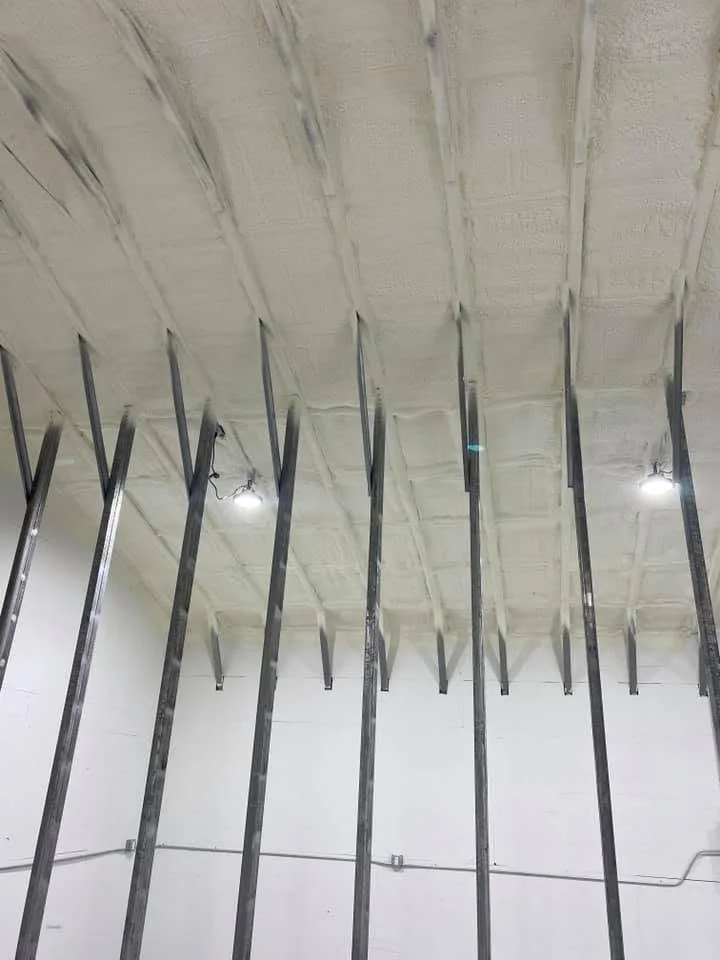
What Makes Residential Spray Foam Insulation Effective Around Gaps and Cracks?
Skeeter Aimone
September 11th, 2026
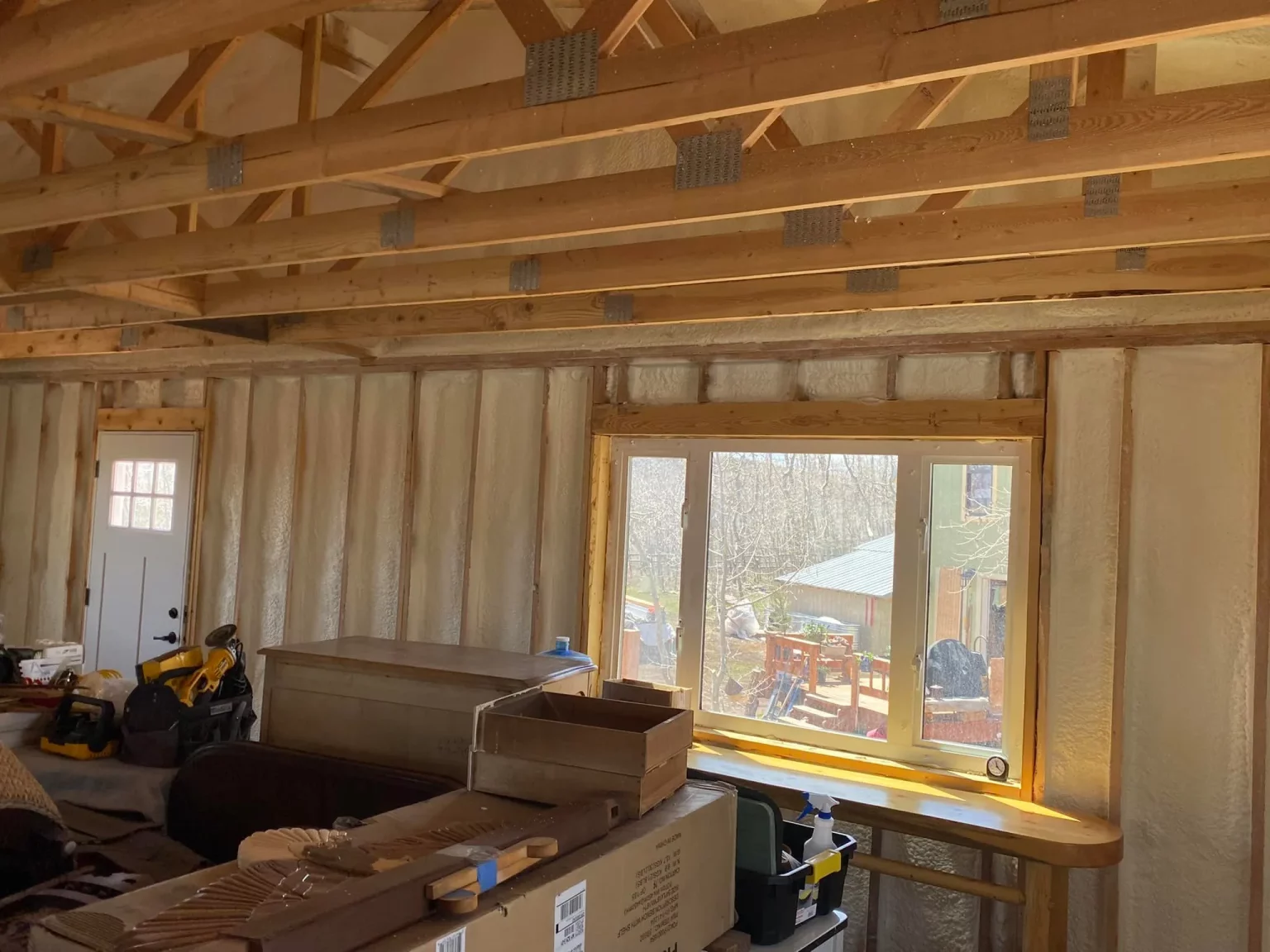
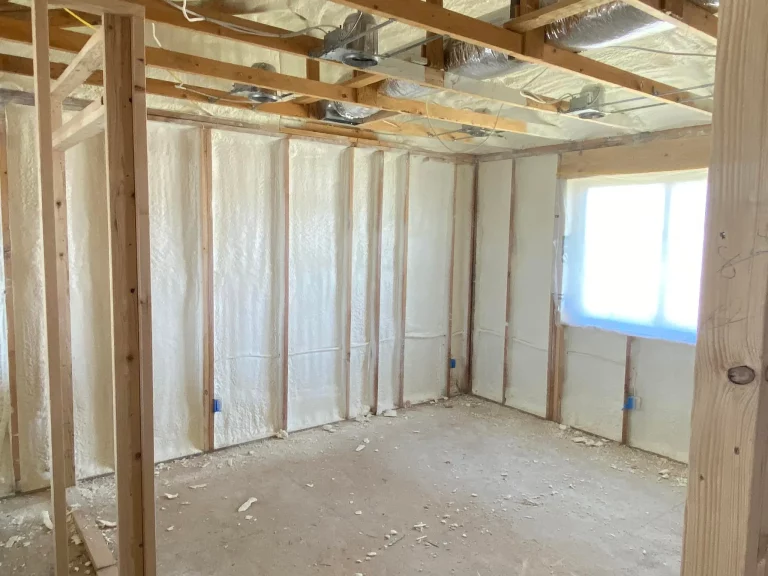
Residential spray foam insulation works around gaps and cracks because it starts as a liquid, expands up to 150 times its applied volume, and adheres directly to the surfaces it touches. That combination lets it fill irregular voids, wire penetrations, and seam lines that batts and rigid boards simply bridge over. Once cured, it functions as insulation and an air barrier in one step, which matters because residential spray foam insulation solutions can help address areas where air leakage affects a home’s performance. The right material depends on the application: open-cell foam suits interior cavities where full fill and sound control matter, closed-cell foam suits rim joists, crawl spaces, and below-grade walls where moisture resistance matters, and hybrid flash-and-batt systems target the leakiest inch of the cavity. Below, we break down the mechanics, the trade-offs, and how to spec each application so the air seal holds.
TL;DR
The EPA’s ENERGY STAR program estimates homeowners save an average of 15% on heating and cooling costs by air sealing and adding insulation, and 9 out of 10 U.S. homes are under-insulated with significant leaks.
Spray foam expands 30 to 150 times its liquid volume, so it conforms to gaps, cracks, and voids instead of leaving them open like cut-to-fit batts.
A DOE Building America guide calls air sealing the attribute that makes spray polyurethane foam outperform fiberglass and cellulose, which are far less able to block airflow.
Open-cell foam delivers roughly R-3.6 per inch and stays vapor permeable; closed-cell foam delivers roughly R-6 to R-6.5 per inch and acts as a vapor retarder at 2 inches or thicker.
Closed-cell is the only acceptable choice below grade, because open-cell foam can absorb and hold up to one-third of its volume in water.
Stack effect drives leakage: warm air escapes high in the home and pulls cold air in low, so attic penetrations and rim joists are the highest-impact sealing targets.
Code requires a thermal barrier, typically half-inch gypsum, over foam in living spaces, with ignition-barrier exceptions in attics and crawl spaces.
Why Small Gaps Waste Disproportionate Energy
Air leakage and heat conduction are different problems. A batt can have a strong R-value on paper and still underperform badly if air moves through or around it, because that moving air carries heated or cooled air straight out of the assembly. ENERGY STAR puts the scale in perspective: if you added up all the leaks, holes, and gaps in a typical home’s envelope, it would equal leaving a window open every day of the year. In winter, the stack effect makes this worse, as warm air rises and exits through high openings while cold outside air gets pulled in through low ones. Every unsealed crack in that loop is a working chimney.
Expansion Turns Liquid Into a Custom Gasket
Spray foam’s edge starts with physics. Per Wikipedia’s spray foam overview, the two-part chemical mix expands 30 to 60 times its liquid volume on contact, and the DOE guide documents even higher ratios in the field: open-cell expands to roughly 150 times its liquid volume, closed-cell to about 35 to 50 times. During that expansion, the foam flows into cracks, crevices, and voids, then cures while bonded to irregular framing, sheathing, and substrates. The result behaves as a gasket poured to the exact shape of the leak, something no pre-cut insulation can match.
It Stops Airflow, Not Just Heat Flow
The same material blocks all three modes of heat transfer, but its defining advantage is convection. Because cured foam forms a continuous, air-impermeable layer, heat cannot ride air currents through the envelope the way it can through loose-fill or batt insulation. The DOE guide states it plainly: filling the gaps, cracks, and voids responsible for uncontrolled air leakage is what makes spray foam performance superior to typical insulation that blocks almost no airflow. Closed-cell foam goes further, adding racking strength to walls and, in high-wind regions, helping glue roof decking to trusses.
Open-Cell vs Closed-Cell Around Gaps and Cracks
Both types seal air, but they behave differently where moisture, thickness, and rigidity matter.
Property
Open-Cell (0.5 lb)
Closed-Cell (2 lb)
R-value per inch
About R-3.6
About R-6 to R-6.5
Expansion ratio
Up to roughly 150x
Roughly 35 to 50x
Cured feel
Soft, flexible
Rigid, walkable
Vapor behavior
Permeable (about 10 perms at 5 inches)
Vapor retarder at 2 inches or more
Water
Absorbs and holds moisture
Hydrophobic
Below grade
Not acceptable
Preferred
Best gap applications
Interior walls, sound control, cold-climate cavities with vapor control
Rim joists, crawl spaces, foundations, roof decks
One planning note from InterNACHI’s insulation resource: closed-cell R-value can drop slightly during its first two years as gas in the cells drifts toward ordinary air, then stabilizes. Spec foam based on its aged R-value, not the lab-fresh number.
Where Spray Foam Delivers the Biggest Wins on Problem Gaps
Not every gap earns the same return. The DOE guide identifies several spots where batts notoriously fail, and foam excels:
Problem Area
Why It Leaks
Foam Strategy
Rim joists and mudsills
Irregular voids usually stuffed with loose batts
Closed-cell, small area, high impact
Attic floor penetrations
Recessed lights, fan housings, top plates
Thin closed-cell coat, then blown loose fill
Cantilevers and floors over unconditioned space
Gravity works against cavity fill
Full foam fill or hybrid system
Basement and foundation walls
Constant moisture exposure
Closed-cell against the wall, thermal barrier over it
Cathedral ceilings and unvented attics
Sloped planes concentrate convective loss
Closed-cell preferred, or open-cell with vapor control
In hybrid flash-and-batt walls, the DOE recommends at least 1.5 inches of closed-cell foam, and 2 inches in climates above 6,000 heating degree days, so the foam’s inner face stays above the dew point.
Mistakes That Undo an Otherwise Good Air Seal
We see the same failures repeat across projects, and each one is avoidable with planning:
Open-cell below grade or in wet zones. Open-cell foam holds water and should never touch foundation walls or damp locations.
Skipping interior vapor control in cold climates. Open-cell foam is airtight but vapor-open, so it needs a vapor-retarding paint or membrane on the interior side, and an exterior wall that cannot dry will trap that moisture.
Treating foam as a substitute for fire protection. Foam in habitable space requires a 15-minute thermal barrier under the International Residential Code, and attic or crawl space exceptions depend on product-specific testing.
Under-specifying foam thickness in hybrids. A flash coat too thin to control condensation sets the cavity up for moisture problems years later.
Assuming any foam fits any job. The two products are not interchangeable, and product evaluation reports dictate which exposed applications are allowed.
Recommendations by Audience
Context
Recommended Approach
Key Notes
New construction, open walls
Full-cavity foam or flash-and-batt
Easiest access, best seal quality
Existing home retrofit
Foam at rim joists, attic penetrations, cantilevers
Target worst leakage first
Basement or crawl space
Closed-cell only
Pair with required thermal or ignition barrier
Budget-scoped project
Seal the attic plane and band joists
Small areas, outsized comfort gains
Signs You’ve Chosen the Right Approach
The contractor talks about climate zone, vapor drive, and drying direction, not just R-value.
Product data sheets with perm ratings and aged R-values are part of the quote, not an afterthought.
Thermal barrier and ignition barrier requirements are addressed before the truck arrives.
Blower-door or infrared verification is offered to confirm the seal, rather than promises alone.
The proposal matches foam type to each specific location instead of one product everywhere.
Get a Gap-by-Gap Insulation Plan From High Country Solutions
Sealing gaps and cracks is equal parts material science and jobsite discipline, and our team at High Country Solutions brings both to every residential project. We match open-cell, closed-cell, and hybrid systems to each cavity, moisture condition, and code requirement, then verify the result. Call us at (307) 248-9063 or email [email protected] to start the conversation.
Your home loses comfort one gap at a time, so let’s close them for good.
FAQs
Can spray foam really seal gaps better than caulk or weatherstripping?
Yes, for anything beyond thin, stationary joints. Caulk and weatherstripping work on predictable linear gaps, while expanding foam fills irregular voids, penetrations, and oversized cracks in one application.
Which foam belongs in a crawl space or basement?
Closed-cell only. Open-cell foam absorbs and holds moisture, while closed-cell resists water and serves as a vapor retarder at proper thickness against foundation walls.
Does spray foam insulation stop drafts immediately?
Once cured, yes. The cured foam forms a continuous air barrier, so drafts tied to envelope leakage drop noticeably after application and curing.
Is a thermal barrier required over spray foam?
In most habitable spaces, yes, the code requires protection equivalent to half-inch gypsum. Attics and crawl spaces may qualify for ignition-barrier exceptions depending on the specific product’s testing.
How long does the air seal from spray foam last?
Decades when installed correctly. Closed-cell foam may see minor R-value drift in its first two years before stabilizing, but the physical air seal does not settle or sag like loose-fill materials.
Sources
ENERGY STAR – Why Seal and Insulate? – EPA estimates on savings from air sealing and insulation, the under-insulation rate of U.S. homes, and comfort benefits.
I’m Skeeter Aimone, owner of High Country Solutions in Alpine, Wyoming, leading the company since 2019. I focus on quality installation, building science, and insulation solutions suited to harsh Wyoming and eastern Idaho conditions.