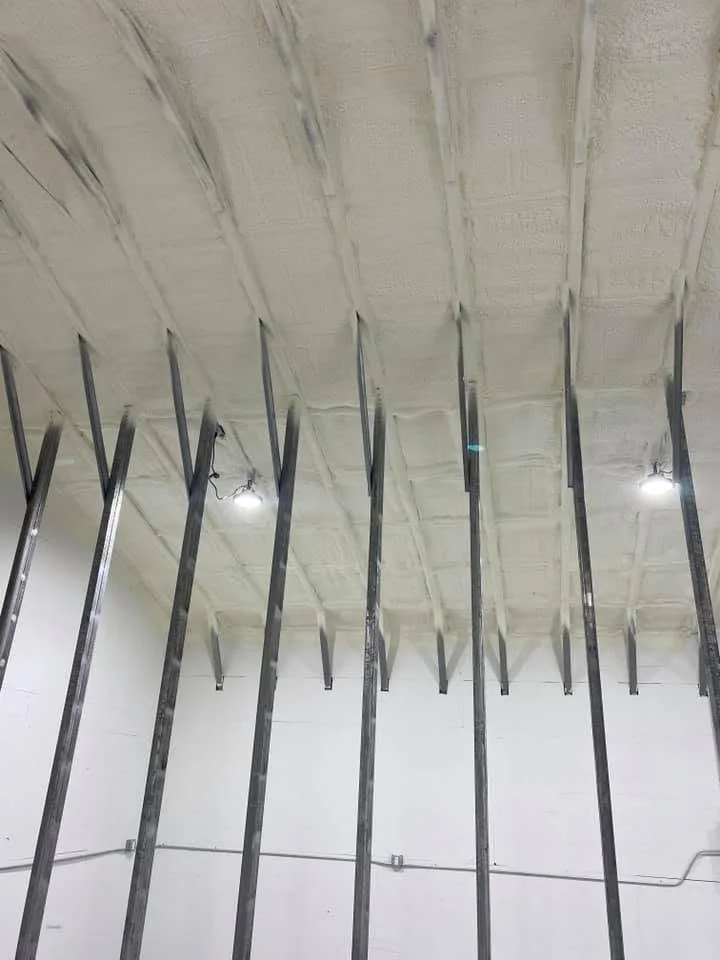
Can Closed-Cell Spray Foam Reduce Heat Loss in Heated Driveway Systems in Victor, ID?
Skeeter Aimone
August 24th, 2026
Yes. Closed-cell spray foam can meaningfully reduce downward heat loss in heated driveway systems, particularly in a cold-climate location like Victor, Idaho. The material delivers a high R-value per inch, acts as a moisture barrier, and conforms to irregular substrates beneath driveway slabs. However, evaluating closed-cell spray foam insulation options requires considering your driveway’s construction type, your budget, and how the insulation layer integrates with the heating system. For many Victor homeowners dealing with USDA Hardiness Zones 4b and 5a, where winter lows regularly reach well below zero, adding insulation under a heated slab is not optional; it is what separates a functional snowmelt system from an expensive waste of energy.
TL;DR
Back and edge heat loss can account for up to 40% of a snowmelt system’s total load, making sub-slab insulation a critical design decision.
Closed-cell spray foam delivers R-5.5 to R-6.5 per inch, outperforming open-cell foam (R-3.6 per inch) and fiberglass batts (R-3.1 to R-4.3 per inch) in per-inch thermal resistance.
Victor, Idaho sits at roughly 6,200 feet in elevation with winter temperatures ranging from single digits to well below freezing, placing heavy demand on any snowmelt system.
Closed-cell foam doubles as a vapor barrier when installed at 2 inches or greater, protecting the slab and heating elements from groundwater moisture.
Rigid foam board (EPS or XPS) is the more common choice for under-slab driveway insulation, but spray foam fills gaps and irregular surfaces that boards cannot.
The right approach depends on whether the driveway is new construction or a retrofit, the substrate condition, and the heating system type (hydronic vs electric).
Why Victor’s Climate Makes This Decision Critical
Victor sits in Teton County at an elevation of approximately 6,200 feet, tucked in a high mountain valley where winters are long, cold, and snowy. According to NOAA data, the nearest reporting station at Driggs-Reed Memorial Airport confirms the region experiences extended sub-freezing conditions from late fall through early spring. The USDA Hardiness Zone Map places Victor in Zones 4b and 5a, meaning extreme minimum temperatures between -25°F and -15°F are part of the normal climate envelope.
A heated driveway system in this environment works against a steep temperature gradient. The slab surface needs to stay at roughly 36°F to 40°F to melt snow, while the ground beneath the slab may be frozen solid at or below 32°F. Without a thermal break between the heated slab and the ground, a significant portion of the system’s energy output conducts downward into the earth rather than upward to melt snow. In poorly insulated installations, that downward heat loss can represent a substantial fraction of total energy consumption.
How Heated Driveway Systems Lose Heat
Heated driveways use either electric cables or hydronic tubing embedded in or beneath a concrete slab, pavers, or asphalt. The system generates heat at the slab level, which then conducts upward to melt snow and ice on the surface. But heat does not only travel up. It moves in all directions, and the paths that draw energy away from the surface fall into three categories:
Downward heat loss (back loss): Heat conducts through the slab and into the ground below. This is the single largest source of waste in uninsulated systems, because the ground beneath a snowmelt slab in Victor is often at or below freezing for months at a time.
Edge heat loss: Heat escapes through the exposed perimeter of the slab where there is no adjacent warm ground or insulation.
Surface losses: Wind, ambient air temperature, and snow accumulation all pull heat from the surface, but these are the loads the system is designed to meet. Downward and edge losses are pure waste.
According to engineering data published in Plumbing & Mechanical Magazine, back and edge heat losses combined can add up to 40% of the total snowmelting load, depending on construction methods, insulation quality, exposure, and ground temperature. That figure alone makes a strong case for installing a thermal barrier beneath any heated driveway in a cold climate.
What Closed-Cell Spray Foam Brings to the Table
Closed-cell spray polyurethane foam (ccSPF) is a medium-density, rigid insulation material applied as a liquid that expands and cures in place. It differs from open-cell foam in several important ways that matter for exterior, below-slab applications:
High R-value per inch. The R-value of closed-cell polyurethane spray foam falls between R-5.5 and R-6.5 per inch, placing it among the highest-performing common insulation materials available. For comparison, open-cell spray foam rates approximately R-3.6 per inch, and fiberglass batts range from R-3.1 to R-4.3 per inch. In a driveway application where total insulation thickness may be limited by structural or grade constraints, getting more thermal resistance per inch matters.
Moisture resistance. Unlike open-cell foam, closed-cell foam is non-porous and resistant to water penetration. At a minimum installed thickness of 2 inches, ccSPF functions as both a vapor barrier and an air barrier. In a driveway application, this means groundwater and moisture migrating up from the soil are less likely to reach the heating elements or the concrete slab.
Conformability. Spray foam adheres to irregular surfaces and fills voids, gaps, and penetrations that rigid board insulation cannot seal. For a driveway substrate that may have uneven grading, embedded utilities, or variable compaction, this is a practical advantage.
Structural contribution. Closed-cell foam adds compressive strength and can reinforce the insulated substrate, though in a driveway application the concrete slab itself carries the structural loads.
The EPA’s archived resource on spray polyurethane foam notes that SPF products are created through a chemical reaction of two components, isocyanates and polyols, which generate an exothermic reaction that produces a rigid, closed-cell structure. This closed-cell structure is what gives the material its high thermal resistance and moisture-blocking properties.
R-Value Comparison: Insulation Options for Heated Driveways
Insulation Material
R-Value per Inch
Vapor Barrier
Best Application
Closed-cell spray foam
R-5.5 to R-6.5
Yes (at 2 in.)
Irregular substrates, retrofits, full coverage
Extruded polystyrene (XPS)
R-5.0
Yes
Flat substrates, new construction
Expanded polystyrene (EPS)
R-3.6 to R-4.2
No (needs separate barrier
Budget new construction
Open-cell spray foam
R-3.6 to R-3.8
No
Interior applications only
Fiberglass batts
R-3.1 to R-4.3
No
Wall cavities, not recommended under slabs
Where Spray Foam Fits in Driveway Construction
The most common approach for new heated driveway construction is to place rigid foam board insulation (typically XPS or high-density EPS) over the compacted subgrade, then lay the heating elements, and pour concrete over the top. This method is straightforward, cost-effective, and well-documented. For new builds with a flat, uniform substrate, closed-cell spray foam insulation can also be considered where its moisture resistance, thermal performance, and ability to conform to irregular surfaces provide specific advantages. Rigid board remains the standard choice.
Closed-cell spray foam enters the conversation in two scenarios:
Retrofit applications. If a heated driveway is being added to an existing slab, or if the substrate is too irregular for board insulation to sit flat, spray foam can be applied directly to the existing surface to create a continuous insulated layer. It fills low spots, seals cracks, and bonds to the substrate in a way that boards cannot.
Edge and perimeter sealing. Even in new construction where board insulation covers the main slab area, spray foam is an effective solution for insulating and sealing the exposed edges and transitions where board insulation is difficult to detail. Edge heat loss is a significant contributor to total waste, and spray foam can seal those perimeter gaps quickly.
Complex geometries. Driveways with curves, slopes, integral garages, or multiple transitions between pavers and concrete are harder to insulate with rigid boards. Spray foam conforms to these shapes without the cutting and fitting that boards require.
That said, spray foam is generally more expensive per square foot than rigid board insulation, and for a simple rectangular driveway on flat ground, the cost premium may not be justified by the performance difference.
Recommendations by Property Type
Scenario
Recommended Insulation
Key Notes
New construction, flat driveway
XPS or EPS rigid board
Most cost-effective; pair with spray foam at edges
New construction, curved or sloped driveway
XPS board with spray foam at transitions
Board covers the main area; foam seals edges and radii
Retrofit over existing slab
Closed-cell spray foam
Conforms to existing surface; fills cracks and voids
Heated paver system
Closed-cell spray foam or XPS
Foam adapts to irregular paver substrate
Commercial or high-traffic driveway
XPS board (high compressive strength)
Closed-cell foam can supplement edges
Signs You Have the Right Insulation Strategy for Your Snowmelt System
A well-designed heated driveway insulation plan will share several characteristics. The insulation layer should be continuous, with no gaps or voids that would allow heat to bypass the thermal barrier. Edge insulation should be detailed, not treated as an afterthought, since perimeter losses compound quickly in cold climates. Choosing the right insulation approach requires considering whether the material is compatible with the slab construction, meaning it can handle the compressive loads of concrete and vehicle traffic without degrading over time. The installer should be able to explain the R-value target for the project and how the insulation integrates with the heating system’s output capacity.
If a contractor proposes a heated driveway in Victor without specifying sub-slab insulation, that is a signal to ask more questions. In this climate, skipping insulation is not a cost-saving measure; it is a decision to pay more in operating energy for the life of the system.
Ready to Build a Heated Driveway That Works in Victor’s Winters?
High Country Solutions has the experience to evaluate your property, recommend the right insulation strategy, and install a heated driveway system designed for the demands of Teton County’s winters. Whether your project calls for rigid board, closed-cell spray foam, or a combination of both, our team will make sure every BTU goes toward keeping your driveway clear, not warming the ground beneath it. Reach out to us at [email protected] or call (307) 248-9063 to discuss your project.
How much heat loss does an uninsulated heated driveway actually waste?
Back and edge heat loss can reach up to 40% of the total snow-melting load depending on insulation, ground temperature, and construction quality, according to engineering data from industry design standards.
Is closed-cell spray foam better than rigid foam board for driveways?
It delivers a higher R-value per inch and seals irregular surfaces better, but it costs more. For flat new construction, rigid board is usually the more practical choice. Spray foam shines in retrofits, edge sealing, and complex geometries.
Can spray foam handle the weight of a concrete driveway?
Closed-cell spray foam is rigid and adds compressive strength, but in standard driveway construction, the foam is not the primary load-bearing layer. The concrete slab distributes vehicle loads, and the foam serves as a thermal barrier beneath it.
How thick should the insulation be under a heated driveway in Victor?
That depends on the heating system design and the target R-value. Many snowmelt system designs call for 1 to 2 inches of insulation with an R-value of at least R-10 beneath the slab, though the exact specification should come from a qualified system designer.
Does spray foam work as a vapor barrier under a driveway slab?
Yes. When installed at a minimum thickness of 2 inches, closed-cell spray foam functions as both a vapor barrier and an air barrier, protecting heating elements and the slab from moisture migrating up from the soil.
Sources
Spray Foam – Wikipedia – Comprehensive reference on spray polyurethane foam types, R-values, thermal properties, and applications including closed-cell foam performance data.
Building Insulation Material – Wikipedia – Detailed comparison of insulation materials including closed-cell vs open-cell foam R-values, moisture resistance, and structural properties.
R-value (Insulation) – Wikipedia – Technical reference for thermal resistance measurements including per-inch R-values for closed-cell polyurethane spray foam and comparison materials.
I’m Skeeter Aimone, owner of High Country Solutions in Alpine, Wyoming, leading the company since 2019. I focus on quality installation, building science, and insulation solutions suited to harsh Wyoming and eastern Idaho conditions.