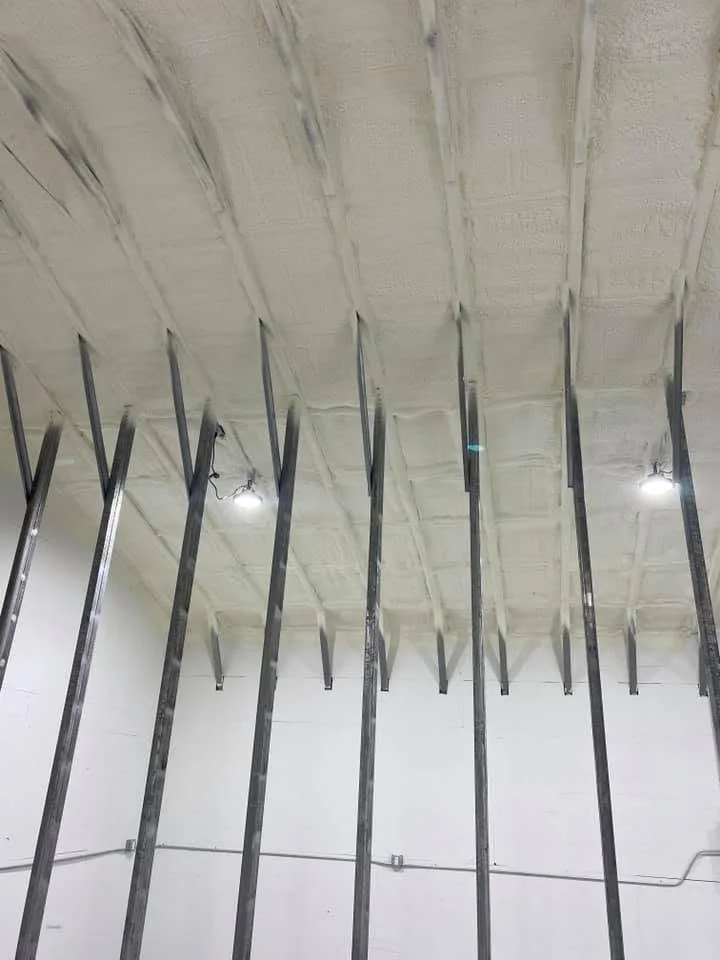
Open-Cell vs Closed-Cell Spray Foam: Which Is Better for Interior Use?
Skeeter Aimone
April 16th, 2026
For most interior applications, open-cell spray foam is the better choice when budget, sound dampening, and large cavity fills are the priority, while closed-cell spray foam is the better option when moisture control, structural rigidity, and high R-value per inch matter most. For a detailed breakdown, see open-cell spray foam insulation applications and benefits. The right pick depends on your climate zone, wall cavity depth, moisture risk, and whether the project demands a built-in vapor barrier. In warmer, mixed-humid climates, open-cell at R-3.7 to R-3.8 per inch provides strong air sealing and thermal performance at a lower material cost. In colder climates, closed-cell at R-6.5 to R-7 per inch delivers the condensation resistance and vapor retarder properties needed to prevent moisture damage inside wall assemblies. Neither type is universally better for interior use, but each has clear strengths that map directly to specific building conditions.
TL;DR
Open-cell spray foam delivers R-3.7 to R-3.8 per inch and costs roughly $0.35 to $0.65 per square foot, making it the budget-friendly option for large interior cavity fills
Closed-cell spray foam delivers R-6.5 to R-7 per inch and costs roughly $1.00 to $2.00 per square foot, offering higher thermal performance in thinner applications
Open-cell foam acts as a superior sound dampener for interior partition walls, reducing noise transfer far better than closed-cell foam
Closed-cell foam functions as a Class II vapor retarder at 1.5 inches thickness, making it the required choice in IECC Climate Zones 5 through 8 for condensation control
Open-cell requires a separate vapor barrier in colder climates, while closed-cell doubles as both insulation and vapor retarder in a single application
Closed-cell adds structural rigidity to wall assemblies at roughly 4 times the density of open-cell (2.0 lb/ft3 vs 0.5 lb/ft3)
Building Science Corporation recommends closed-cell exclusively for unvented conditioned attics in Climate Zones 5 and higher
How Open-Cell and Closed-Cell Spray Foam Actually Work
Both products start as two liquid chemicals that react on contact and expand rapidly. The difference comes down to what happens inside those expanding bubbles. In open-cell spray foam, the cell walls rupture during expansion, leaving a porous, sponge-like structure. In closed-cell spray foam, the cells remain intact, trapping a blowing agent gas inside sealed pockets. That structural difference is what drives every performance gap between the two.
According to Johns Manville’s technical comparison, closed-cell spray foam has a density of approximately 2.0 lb/ft3 compared to open-cell at 0.5 lb/ft3. That fourfold difference in density directly affects R-value, vapor permeability, sound absorption, and cost.
Head-to-Head Performance Comparison
Property
Open-Cell Spray Foam
Closed-Cell Spray Foam
R-Value per Inch
R-3.7 to R-3.8
R-6.5 to R-7.0
Density
~0.5 lb/ft3
~2.0 lb/ft3
Air Barrier
Yes (at 3.5″ minimum)
Yes (at 1″ minimum)
Vapor Barrier
No (vapor permeable)
Yes (Class II at 1.5″)
Expansion Rate
Up to 100x original volume
Up to 30x original volume
Sound Dampening
Excellent
Moderate
Structural Strength
Low
High (adds rigidity)
Cost per Sq Ft
$0.35 to $0.65
$1.00 to $2.00
Moisture Permeability
High (breathable)
Low (acts as a retarder)
R-Value and Thermal Performance for Interior Walls
R-value measures thermal resistance, and this is where the two products diverge significantly. A standard 2×4 wall cavity with 3.5 inches of open-cell spray foam yields roughly R-13. The same cavity filled with closed-cell spray foam delivers approximately R-23 to R-25. In a 2×6 wall with 5.5 inches, open-cell reaches R-20 to R-21 while closed-cell pushes R-36 to R-39.
The U.S. Department of Energy notes that foam insulation materials carry higher R-values than traditional batt insulation and form an effective air barrier, which eliminates additional air-sealing tasks during construction. This dual function is what makes spray foam appealing for interior applications where both thermal control and airtightness are targets.
When wall cavity depth is limited, such as in retrofit projects with 2×4 framing, closed-cell delivers substantially more thermal resistance in the same space. If cavity depth is not a constraint, open-cell can achieve comparable total R-values by filling deeper cavities at a lower per-inch cost.
Moisture Control and Vapor Barrier Considerations
Moisture management is where the decision between these two products carries the most risk. Closed-cell spray foam at 1.5 inches thickness meets the International Residential Code requirements for a Class II vapor retarder in IECC Climate Zones 5 through 8. This means it simultaneously insulates, air-seals, and controls vapor diffusion in a single application.
Open-cell spray foam, by contrast, is vapor-permeable. In mixed-humid and cold climates, using open-cell alone in wall cavities without an additional vapor retarder creates a real risk of condensation forming inside the assembly. Building Science Corporation’s residential spray foam guide recommends that in Climate Zones 5 and higher, either closed-cell should be used alone, or open-cell should be paired with a separate interior vapor retarder to meet code-prescribed condensation control requirements. For more detail, see open-cell spray foam vapor control requirements.
For interior applications in bathrooms, laundry rooms, kitchens, and below-grade spaces, closed-cell is the safer choice because it actively resists moisture vapor transmission. Open-cell can absorb and hold moisture, which in extreme cases can lead to prolonged drying times and potential mold risk if the wall assembly is not designed to dry properly.
Sound Dampening and Acoustic Performance
One area where open-cell spray foam clearly outperforms closed-cell is sound attenuation. The open, porous cell structure absorbs sound waves rather than reflecting them, making open-cell an excellent choice for interior partition walls, home theaters, office demising walls, and mechanical room enclosures.
Closed-cell foam is denser and more rigid, which means it transmits sound more readily. It still reduces sound transfer compared to an empty cavity, but it does not match the acoustic absorption qualities of open-cell. For projects where noise control between rooms is a primary driver, open-cell is the clear winner regardless of climate zone considerations.
Cost Breakdown for Interior Applications
Material cost is the most visible difference between these two products, but the total installed cost picture is more nuanced.
Cost Factor
Open-Cell
Closed-Cell
Material Cost per Sq Ft
$0.35 to $0.65
$1.00 to $2.00
Installation (1,500 sq ft home)
$1,500 to $3,500
$4,000 to $7,500
Wall Cavity (2×4, R-13 to R-25)
Lower total cost
Higher total cost
Achieving Same R-Value
Requires more depth
Requires less depth
Separate Vapor Barrier Needed
Yes (cold climates)
No (at 1.5″+ thickness)
Open-cell costs significantly less per board foot, but achieving the same total R-value as closed-cell requires roughly double the thickness. In a 2×4 wall where space is fixed, open-cell simply cannot match the thermal resistance of closed-cell. The cost advantage of open-cell is most pronounced in deep cavities like 2×6 walls, cathedral ceiling rafter bays, and floor assemblies, where the extra thickness is available without compromising interior space.
Climate Zone Recommendations
Climate plays a central role in determining which foam type performs best for interior use. Building Science Corporation provides clear guidance based on IECC climate zones:
IECC Climate Zones 1 through 4 (warm to mixed): Both open-cell and closed-cell perform well. Open-cell is the more economical choice for standard wall cavities and attics. Closed-cell is preferred for unvented conditioned attics in humid zones where moisture control at the roof deck is critical.
IECC Climate Zones 5 through 8 (cold to very cold): Closed-cell spray foam is recommended for its condensation control and Class II vapor retarder properties. Where open-cell is used, an additional vapor retarder must be installed on the warm side of the assembly. Hybrid approaches combining a thin layer of closed-cell against the sheathing with open-cell filling the remainder of the cavity are also code-compliant and cost-effective.
Indoor Air Quality and Safety Considerations
Both spray foam types involve chemical reactions during installation that release isocyanates and other volatile organic compounds. The EPA has documented health concerns related to isocyanate exposure during and immediately after spray foam application, including risks of asthma, lung irritation, and chemical sensitization. The Consumer Product Safety Commission has also issued health and safety recommendations for spray polyurethane foam insulation.
Properly installed spray foam that has fully cured does not continue to off-gas at harmful levels. The key safety factors include:
Ensuring adequate ventilation during application and the 24 to 72-hour curing period
Requiring occupants to vacate the space during installation
Using experienced, certified installers who follow manufacturer mixing ratios precisely
Confirming that the specific product carries the required fire-resistance ratings (flame spread index of 25 or less, smoke-developed index of 450 or less) per building code requirements
Building codes require that all foam plastic insulation be separated from the interior occupied space by an approved 15-minute thermal barrier, typically half-inch gypsum wallboard, unless the installation meets specific ignition barrier exceptions for attics and crawlspaces.
Real-World Contractor Scenarios
Scenario
Property Type
Recommended Option
Estimated Cost
New construction interior walls, Climate Zone 3, 2×6 framing
Single-family home, 2,400 sq ft
Open-cell (R-20, sound-dampening bonus)
$2,200 to $3,800
Basement interior foundation walls, Climate Zone 6
Interior partition walls between the home office and the living area
Remodel, existing 2×4 walls
Open-cell (acoustic isolation priority)
$800 to $1,500
Unvented conditioned attic, Climate Zone 5
Custom home, 1,800 sq ft attic floor
Closed-cell (code-required vapor retarder)
$5,400 to $10,800
Bathroom and kitchen interior walls, mixed-humid climate
Renovation, high-moisture zones
Closed-cell (moisture resistance)
$1,200 to $2,500
Factors That Influence the Decision
Several variables determine which product performs better in a given interior application:
Climate zone: Cold climates favor closed-cell for condensation control; warm climates allow open-cell without vapor barrier requirements
Cavity depth: Shallow cavities (2×4 framing) benefit more from closed-cell’s higher R-value per inch
Moisture risk: Bathrooms, kitchens, basements, and below-grade spaces call for closed-cell vapor retarder properties
Sound control priority: Home theaters, offices, and multi-family demising walls benefit from open-cell’s acoustic absorption
Budget constraints: Open-cell costs 40 to 60 percent less per square foot than closed-cell
Structural needs: Closed-cell adds shear strength and rigidity to wall assemblies; open-cell does not
Code compliance: Climate Zones 5 and higher require either closed-cell or open-cell plus a separate vapor retarder
Ventilation strategy: Spray foam creates tight building envelopes, making mechanical ventilation systems essential for indoor air quality, regardless of foam type
Who Open-Cell Spray Foam Is Best For (and Who Should Avoid It)
Ideal for:
Builders and contractors working in Climate Zones 1 through 4 with moderate temperature deltas
Projects where sound dampening between rooms is a primary requirement
Large cavity fills in 2×6 or deeper framing, where maximum thickness is available
Budget-sensitive projects that still need air sealing and solid thermal performance
Interior partition walls in offices, theaters, and multi-family buildings
Not ideal for:
Projects in Climate Zones 5 through 8, unless a separate vapor retarder is planned
Below-grade or basement interior walls with high moisture exposure
Bathroom and kitchen wall assemblies without additional moisture protection
Any application where a built-in vapor retarder is code-required or structurally necessary
Who Closed-Cell Spray Foam Is Best For (and Who Should Avoid It)
Ideal for:
Builders and contractors in Climate Zones 5 through 8 need condensation control
Basement foundation, interior walls, and below-grade applications
Unvented conditioned attics in cold climates
Retrofit projects with shallow cavities where maximizing R-value in limited space matters
Projects requiring structural reinforcement in addition to insulation
Not ideal for:
Projects where sound dampening between interior rooms is the primary goal
Budget-constrained projects covering large areas without a corresponding need for vapor barrier performance
Applications where the wall assembly needs to dry in both directions (open-cell allows more drying potential)
Get Expert Guidance on Your Next Spray Foam Project
Choosing between open-cell and closed-cell spray foam for interior applications requires evaluating your climate zone, building assembly design, moisture risk, and budget targets. At High Country Solutions, our team has the experience to assess your specific project conditions and recommend the spray foam system that delivers the best long-term performance. Whether you need closed-cell for a basement in a cold climate or open-cell for sound-dampened partition walls, we will walk you through the right approach for your build.
Can open-cell spray foam be used in basement interior walls?
Open-cell can be installed in basements, but Building Science Corporation recommends closed-cell spray foam for basement interior foundation walls in IECC Climate Zones 5 and higher due to its vapor retarder properties and superior moisture resistance.
Does spray foam insulation require an ignition barrier on interior walls?
Yes, building codes require all foam plastic insulation to be covered by an approved 15-minute thermal barrier, such as half-inch gypsum wallboard, when installed on interior walls facing occupied living spaces.
How long after spray foam installation can occupants re-enter the home?
Most manufacturers and the EPA recommend a minimum of 24 to 72 hours after application before re-occupancy, depending on the specific product, ventilation conditions, and thickness installed. Always follow the installer’s and manufacturer’s re-entry guidelines.
Can open-cell and closed-cell spray foam be used together in the same wall assembly?
Yes, Building Science Corporation describes hybrid wall assemblies where a thin layer of closed-cell is sprayed against the sheathing for vapor retarder performance, with open-cell filling the remaining cavity depth for added R-value and sound control.
Is the higher cost of closed-cell spray foam worth it for interior walls?
In cold climates, yes. The vapor retarder function, condensation control, and higher R-value per inch make closed-cell the code-recommended choice in Climate Zones 5 through 8. In warmer climates with standard wall cavities, open-cell often delivers sufficient thermal performance at a significantly lower cost.
U.S. Department of Energy – Insulation Materials – Government resource covering insulation material types, R-values, and performance characteristics, including spray foam insulation properties.
I’m Skeeter Aimone, owner of High Country Solutions in Alpine, Wyoming, leading the company since 2019. I focus on quality installation, building science, and insulation solutions suited to harsh Wyoming and eastern Idaho conditions.