Mineral Wool vs Fiberglass Insulation: Which Option Is Better for Your Home?
Quick answer: In the mineral wool vs fiberglass insulation debate, mineral wool usually wins on fire resistance, moisture handling, sound…


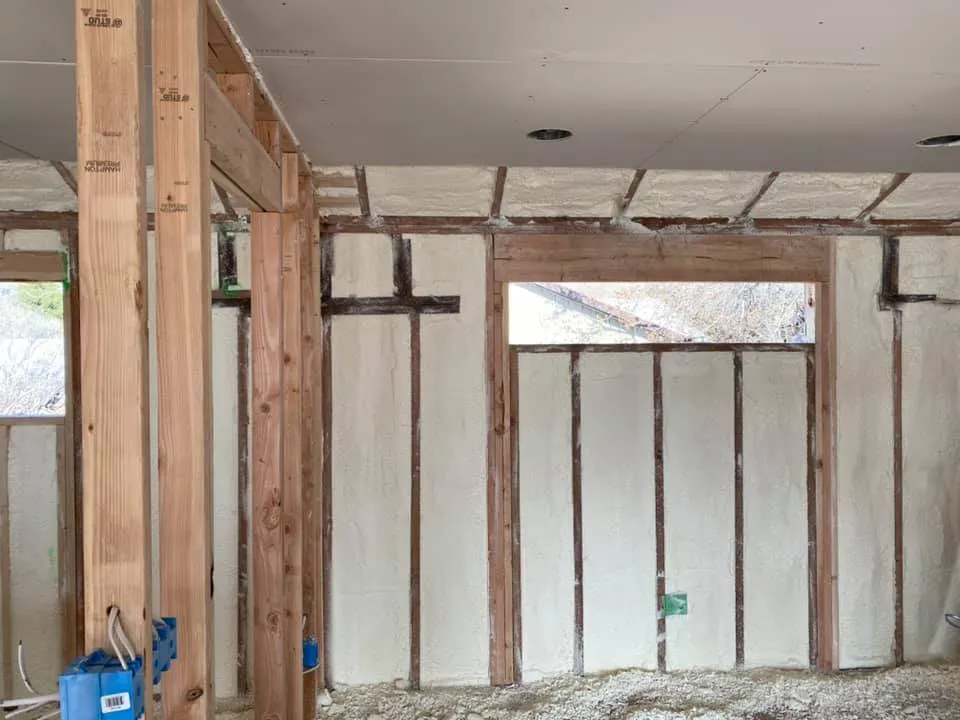
Builders in Victor, ID, who partner with spray foam insulation contractors consistently win more bids because they offer homeowners a measurable performance advantage that fiberglass batts and blown-in alternatives simply cannot match. Victor sits in a cold climate zone where heating demands are high, and spray foam insulation delivers higher R-values per inch while simultaneously creating an airtight seal that eliminates drafts and thermal bridging. When builders bundle professional spray foam installation into their proposals, they differentiate themselves from competitors still relying on traditional insulation methods, and they give homeowners a compelling reason to choose a more energy-efficient, durable home. The right partnership depends on builder goals, but for those focused on winning custom home builds and retrofits in Teton Valley, spray foam is a serious competitive edge. Working with a builder-focused insulation expert can help turn that advantage into a long-term business asset.
Victor sits at an elevation of 6,207 feet in Teton County, where winters are long, and temperatures regularly drop well below freezing. The Wikipedia building insulation entry notes that in cold climates, the main goal is reducing heat flow out of the building, and that thermal bridges through framing and gaps in the building envelope are major sources of heat loss. Traditional fiberglass batts leave gaps around studs, pipes, and electrical penetrations, which means air moves through those spaces continuously. Spray foam, by contrast, expands into every gap and crevice, sealing the building envelope while insulating it.
The U.S. Department of Energy’s Energy Saver guide on types of insulation confirms that sprayed foam and foamed-in-place insulation can fill even the smallest cavities and create an effective air barrier. The guide distinguishes between two main types: closed-cell foam, which has a higher R-value and provides stronger resistance against moisture and air leakage, and open-cell foam, which is lighter and less expensive. Both types are typically made with polyurethane, and both outperform traditional batt insulation in real-world thermal performance because they address air sealing and thermal resistance simultaneously.
For builders in Victor submitting competitive bids, this dual benefit means they can offer homeowners a tighter, warmer home without additional weatherization steps like caulking, housewrap, and taping joints that fiberglass installations require. That translates directly into a cleaner scope of work and a more attractive proposal.
The R-value system, described in detail on Wikipedia’s building insulation page, measures thermal resistance per unit of insulation material. However, a single R-value does not account for the quality of construction or local environmental factors, and construction quality issues such as inadequate vapor barriers and problems with draft-proofing can undermine installed R-values.
Spray foam addresses both the thermal resistance and the air sealing problems in a single step. Closed-cell spray foam delivers roughly R-6.5 to R-7 per inch, compared to fiberglass batts at roughly R-2.2 to R-3.7 per inch. In cold climates like Victor’s, this means builders can achieve the same or better thermal performance with less wall cavity depth, or they can exceed code minimums within standard framing dimensions while providing enhanced building protection against air leakage and moisture issues.
The Wikipedia page on polyurethane explains that closed-cell foam is produced when high-density cells are closed and filled with a gas that helps the foam expand, making it particularly well-suited for rigid thermal insulation applications. Open-cell foam cells are filled with air, giving them a spongy texture that works well for interior wall cavities where moisture resistance is less of a concern.
Moisture control is a major concern in cold climates. Condensation can form within wall assemblies when warm indoor air meets cold surfaces, leading to mold growth and structural damage. The Wikipedia building insulation reference notes that insufficient thermal insulation in buildings can cause high relative humidity, leading to condensation and mold problems. Closed-cell spray foam acts as a vapor retarder and a moisture barrier in many applications, which gives builders an advantage when designing assemblies for Victor’s freeze-thaw cycles.
Homeowners and architects who understand building science will favor proposals that address moisture proactively. Builders who partner with spray foam insulation contractors can point to these moisture management benefits as part of their value proposition.
The ASHRAE 90.1 standard is the U.S. energy standard for commercial and some residential buildings. It sets prescriptive minimum R-values for walls, roofs, and floors based on climate zone, with cold climate zones requiring the highest insulation values. Builders who use spray foam can meet or exceed these requirements more easily because of the material’s higher per-inch R-value and its ability to provide continuous insulation when applied as a thermal break.
In residential construction, ASHRAE 90.1 prescribes minimum R-values that vary by climate zone and wall type. For wood-framed walls in cold zones, the requirements can reach R-13 plus continuous insulation. Spray foam, applied as either closed-cell or open-cell within the stud cavity, can achieve these targets without the need for additional rigid foam sheathing. This simplifies the build, reduces material costs in some cases, and gives builders a compliance advantage.
Homeowners in Victor are increasingly aware of energy performance. With median home values climbing and heating costs remaining a concern for Teton Valley residents, energy efficiency is a genuine selling point. Builders who can demonstrate that their insulation approach exceeds minimum code requirements and provides measurable energy savings have a stronger position in competitive bid situations. Many gain that advantage through spray foam solutions for builders.
Victor has experienced significant growth, with building permit data showing active new construction activity. The population has grown substantially since 2000, and the city has seen consistent single-family home building permits issued year over year. This growth creates a competitive environment where builders need every advantage to stand out.
Victor’s rural setting and high elevation present specific construction challenges. Many new builds are custom homes on rural lots where energy efficiency matters more because utility infrastructure may be limited or because homeowners want off-grid capability. Builders who offer spray foam insulation can address these clients’ needs for tighter building envelopes and better thermal performance, especially in pole barns and outbuildings that are common in the area.
| Benefit | What It Means for Builders | Bid Impact |
|---|---|---|
| Higher R-value per inch | Better thermal performance in thinner cavities | Allows smaller wall depths or exceeds code with standard framing |
| Integrated air sealing | Eliminates the need for separate caulking and housewrap in insulated areas | Reduces scope complexity and line-item costs |
| Moisture resistance | Closed-cell foam resists water infiltration and vapor drive | Addresses condensation concerns in cold climates directly |
| Faster installation | Spray application covers large areas quickly | Shortens construction timelines and reduces labor coordination |
| Professional expertise | Certified installers ensure correct mixing, thickness, and coverage | Reduces callback risk and warranty claims |
| Code compliance | Meets or exceeds ASHRAE 90.1 prescriptive requirements | Simplifies inspections and energy code compliance documentation |
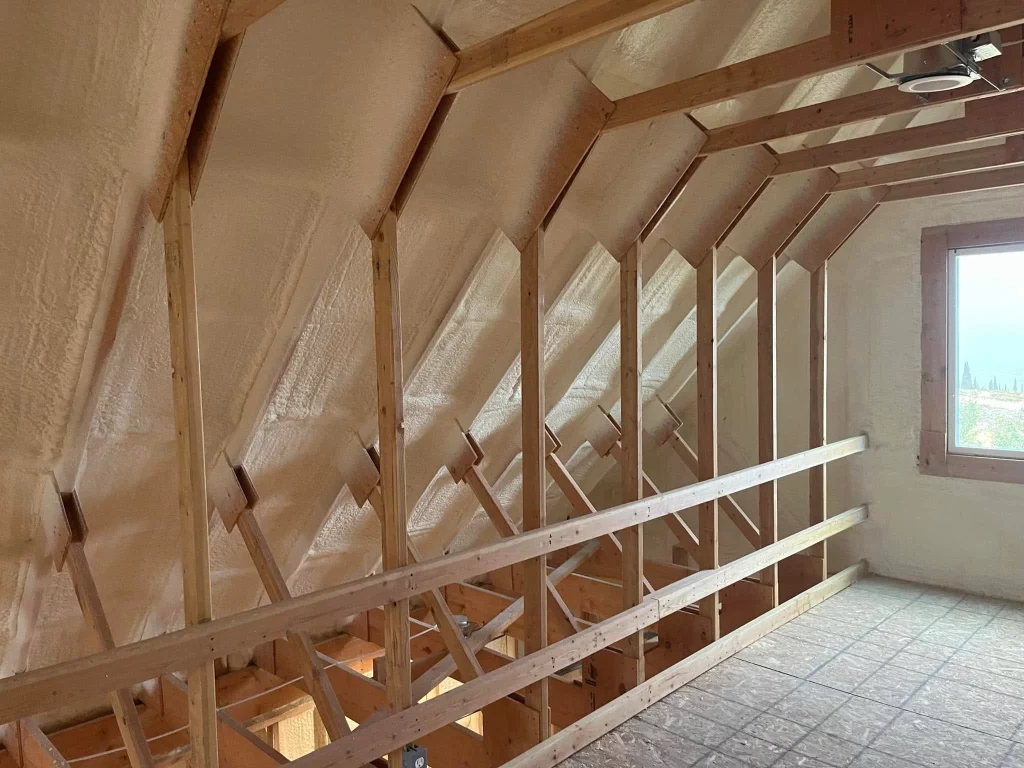
For custom home builders in Victor, spray foam insulation is the strongest differentiator. Homeowners investing in custom builds expect superior performance, and spray foam delivers it. Use closed-cell foam in walls and rim joists for maximum moisture protection, and consider open-cell foam in interior partitions and attic assemblies where cost sensitivity is higher.
Retrofit insulation is challenging because existing wall cavities may be obstructed. Spray foam can be injected into closed wall cavities and can fill irregular spaces that fiberglass batts cannot reach. Builders bidding on energy retrofit projects can offer spray foam as a solution that addresses both insulation and air sealing without opening wall surfaces.
Pole barns and agricultural structures are common in Teton Valley. These metal-sided buildings are notoriously difficult to insulate with traditional materials. Spray foam adheres directly to metal substrates, seals gaps around fasteners and framing, and provides both insulation and condensation control in a single application.
High Country Solutions provides professional spray foam insulation services for builders and homeowners, including closed-cell spray foam, open-cell spray foam, insulation removal and replacement, attic insulation, and pole barn insulation. Our experienced team works directly with builders to ensure every project meets code, performs as specified, and gets installed on schedule. Whether you are bidding a custom home in Victor, a retrofit project, or a pole barn insulation job, we can help you deliver a proposal that stands out.
Request a Quote | Schedule an Insulation Consultation
Call us at (307) 248-9063 or email [email protected] to discuss your next project. When your insulation partner delivers quality on time, your bids get stronger.
Spray foam provides a higher R-value per inch and acts as both insulation and an air barrier, allowing builders to offer homeowners a tighter, more energy-efficient home than traditional fiberglass batts can deliver.
Closed-cell spray foam is the best choice for cold climates because it delivers R-6.5 to R-7 per inch and resists moisture infiltration, making it ideal for walls, rim joists, and below-grade applications.
Yes, spray foam can meet or exceed ASHRAE 90.1 prescriptive R-value requirements for cold climate zones because of its higher per-inch thermal resistance and ability to provide continuous air sealing.
Spray foam installs quickly, covers large areas in a single application, and eliminates separate air sealing steps like caulking and taping, which reduces coordination complexity and speeds up the build schedule.
Spray foam adheres directly to metal substrates and seals around framing and fasteners, making it one of the most effective insulation solutions for pole barns and metal-sided structures in rural areas.