Insulated vs Uninsulated Walls: How Big Is the Energy Difference?
The energy difference between insulated and uninsulated walls is substantial, typically ranging from 30% to over 50% in heating and…


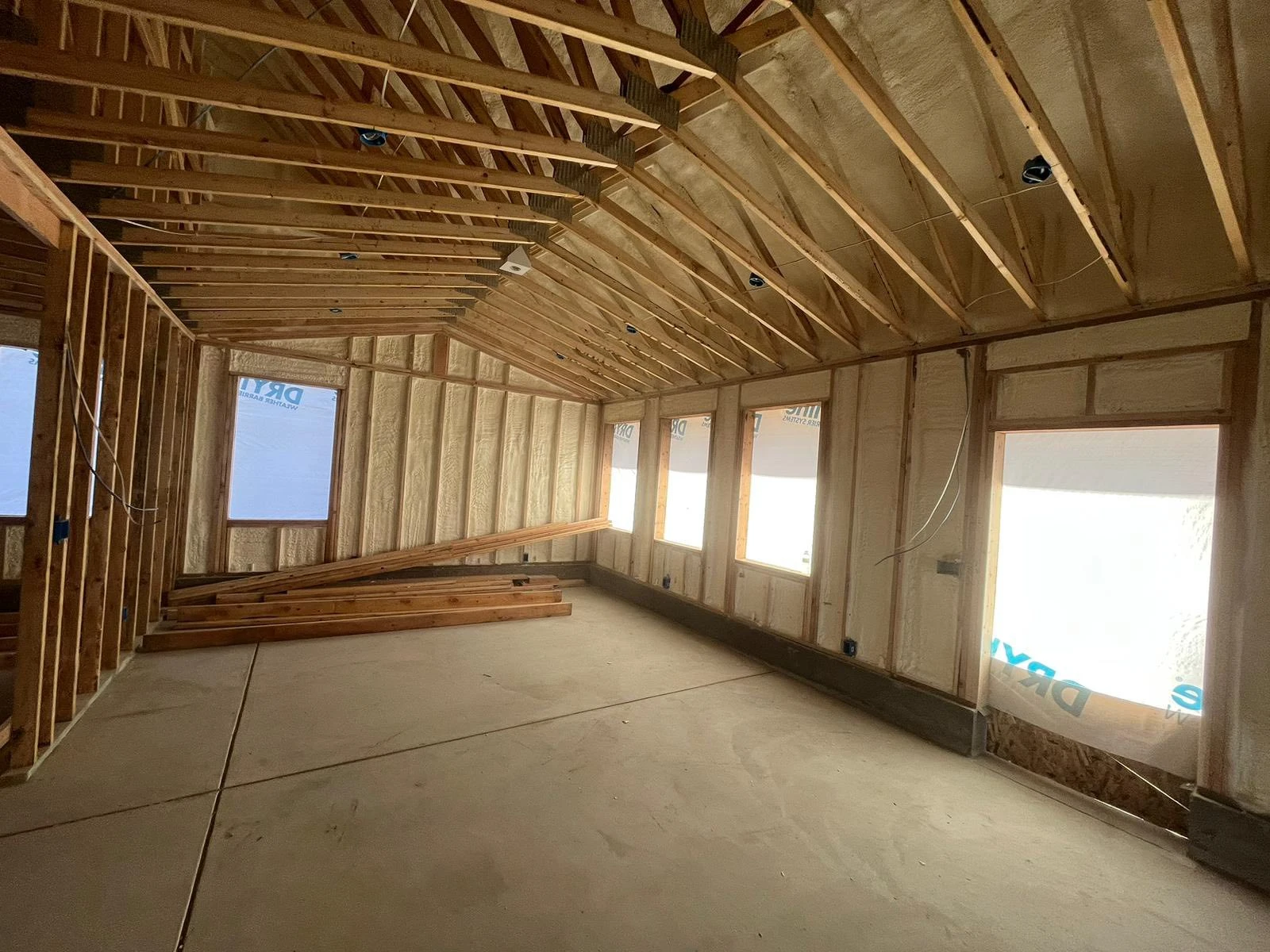
Commercial insulation performance in 2026 is shaped by a convergence of stricter energy codes, evolving material science, and rising expectations around building durability. The right insulation strategy depends on several technical variables, including thermal resistance, moisture control, fire safety compliance, air barrier integrity, and structural load capacity. Whether you are specifying insulation for a new warehouse, retrofitting an office building, or upgrading a healthcare facility, understanding how these technical factors interact will determine real-world energy savings, occupant comfort, and code compliance for years to come. Below, we break down the key performance drivers that contractors, architects, and building owners need to evaluate heading into 2026.
Thermal resistance, measured as R-value, remains the baseline metric for comparing insulation products. However, the conversation in 2026 has shifted from “what is the rated R-value” to “what is the effective R-value under real-world conditions.” This distinction matters because manufacturers report R-values under controlled laboratory conditions that do not account for gaps, compression, thermal bridging, or moisture accumulation.
According to the U.S. Department of Energy, the maximum thermal performance of any insulation is highly dependent on proper installation. A poorly installed high-R product can underperform a correctly installed moderate-R product. For commercial specifiers, this means the installation method, fastener patterns, joint detailing, and field quality control are just as important as the material specification on the data sheet.
The ASHRAE 90.1 standard, which serves as the model energy code for most U.S. commercial construction, sets minimum R-value requirements by climate zone and assembly type. The 2022 edition, which many jurisdictions are adopting for 2026 compliance, increased requirements for roof insulation, opaque walls, and below-grade walls in several climate zones. Contractors working across multiple states need to track which edition has been adopted locally, as requirements can differ significantly even between adjacent jurisdictions.
| Climate Zone | Minimum Roof R-Value (ASHRAE 90.1-2022) | Minimum Wall R-Value | Key Consideration |
|---|---|---|---|
| 1-2 (Hot) | R-25 ci | R-13 + R-3.8 ci | Vapor drive is inward; moisture control is critical |
| 3-4 (Mixed) | R-25 ci | R-13 + R-5 ci | Seasonal swing creates dual vapor drive risk |
| 5-6 (Cold) | R-30 ci | R-13 + R-7.5 ci | Condensation control and air sealing are priorities |
| 7-8 (Very Cold) | R-35 ci | R-13 + R-10 ci | Thermal bridging at framing is the biggest loss path |
“ci” stands for continuous insulation, meaning the insulation layer is uninterrupted by framing members, which significantly reduces thermal bridging.
Moisture is the single most damaging factor to commercial insulation systems. When insulation absorbs water, whether through condensation, leaks, or vapor diffusion, its R-value drops, and the risk of mold, corrosion, and structural decay increases. In 2026, code bodies and building scientists are placing more emphasis on hygrothermal analysis, which evaluates how heat, air, and moisture move through building assemblies.
The key technical decisions around moisture include selecting the correct vapor retarder class, positioning vapor barriers on the correct side of the assembly (the warm side in heating climates, the exterior side in cooling climates), and incorporating drainage capacity in wall and roof systems. For commercial buildings in mixed or cold climates, this often means using a smart vapor retarder that varies its permeability based on humidity conditions.
Owens Corning identifies moisture resistance and durability in extreme conditions as critical selection factors for commercial roof insulation, particularly for low-slope assemblies where ponding water and condensation are persistent risks.
Fire performance is a technical factor that cannot be compromised in commercial construction. Insulation materials must meet specific flame spread and smoke developed indices, typically tested under ASTM E84 or UL 723. For roof assemblies, FM Global’s FM 4880 standard provides approval ratings that many insurance carriers and building owners require.
In 2026, fire code scrutiny has intensified due to several high-profile commercial fires involving combustible insulation materials. Building owners and specifiers are increasingly favoring non-combustible options like mineral wool, fiberglass, and gypsum-based systems for occupied commercial spaces. The National Gypsum Company highlights that understanding FM, ASTM, and UL standards is essential for specifying durable and code-compliant low-slope commercial roof systems.
Fire-rated assemblies also require careful attention to joint detailing, penetration firestopping, and the compatibility of insulation with the surrounding structural and cladding materials. A fire-rated roof assembly can be compromised if the insulation does not maintain its integrity under fire exposure or if incompatible materials create flammable gas channels.
Air leakage through the building enclosure is responsible for a significant portion of energy waste in commercial buildings. While insulation resists conductive heat transfer, air barriers control convective heat loss and moisture transport. The two systems must work together to deliver rated performance.
In 2026, ASHRAE 90.1 and the International Energy Conservation Code (IECC) include prescriptive air barrier requirements for commercial buildings, mandating that the building enclosure be tested and verified to meet maximum air leakage rates. For contractors, this means that insulation installation must be coordinated with air barrier detailing at transitions, penetrations, joints, and parapets.
Common air barrier materials include fluid-applied membranes, self-adhered sheet membranes, spray foam (when used as a complete air barrier), and insulated metal panels with factory-applied seals. The effectiveness of any air barrier depends on continuity, which requires careful planning and execution at every intersection and transition point.
Commercial roof insulation must withstand structural loads, including dead loads, live loads, and wind uplift forces. In hurricane-prone and high-wind regions, the insulation and its attachment system must meet specific uplift resistance requirements tested under FM 4470 or similar protocols.
The compressive strength of the insulation material is also critical. Low-density insulation boards installed under ballasted or mechanically attached roof membranes can compress over time under foot traffic or equipment loads, reducing their effective thickness and R-value. For 2026 projects, specifiers should evaluate the long-term compressive resistance of insulation products, particularly for roofs that will see maintenance traffic or support rooftop equipment.
Bar Chart Suggestion: Compare the compressive strength (psi) of common commercial insulation materials, including polyisocyanurate, extruded polystyrene, expanded polystyrene, mineral wool, and fiberglass, to illustrate how material choice affects structural performance under load.
| Material | R-value per Inch | Fire Class | Moisture Resistance | Best Commercial Application |
|---|---|---|---|---|
| Polyisocyanurate | R-5.6 to R-6.5 | Class A (with facer) | Moderate | Low-slope roof systems, metal buildings |
| Extruded Polystyrene (XPS) | R-5.0 | Class A (with cover) | High | Below-grade walls, plaza decks |
| Expanded Polystyrene (EPS) | R-3.6 to R-4.2 | Class A (with cover) | Moderate | Structural insulated panels, cavity fill |
| Mineral Wool | R-3.3 to R-4.2 | Non-combustible | High | Fire-rated walls, acoustic applications |
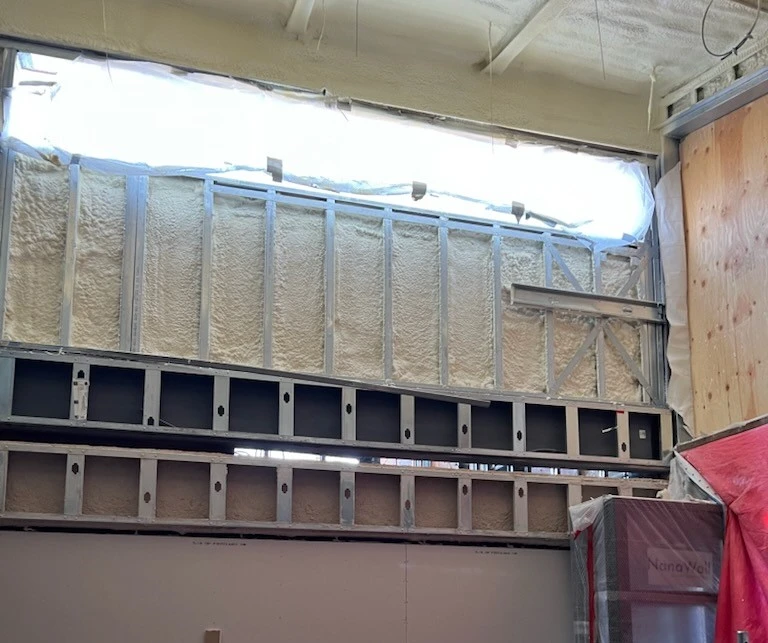
| Spray Polyurethane Foam | R-3.5 to R-6.5 | Class A (with intumescent) | High | Irregular cavities, air barrier applications |
| Fiberglass (batt) | R-2.9 to R-3.8 | Class A | Low | Interior walls, standard cavities |
New Construction (Office, Retail, Healthcare): Prioritize continuous insulation systems that integrate air barriers and vapor retarders into a single assembly. Specify non-combustible materials for occupied spaces and ensure ASHRAE 90.1-2022 compliance from the design phase.
Metal Building Retrofit: Use insulated metal panels or spray foam systems that provide both high R-value and air barrier continuity. Address thermal bridging at purlins and girts with thermal breaks or continuous insulation layers.
Warehouse and Distribution: Focus on roof insulation R-value and air sealing at the roof-to-wall transition. Fiberglass blanket insulation is cost-effective for large roof areas, but verify that attachment systems meet wind uplift requirements.
Cold Storage and Food Processing: Select insulation with high moisture resistance and low vapor permeability. Polyisocyanurate and spray foam are common choices. Ensure the vapor barrier is continuous and properly sealed at all penetrations.
Existing Building Energy Upgrades: Commission a blower door test or thermal scan before specifying insulation. Address air leaks and moisture issues first, then layer in additional insulation to meet current code requirements without disturbing existing assemblies.
A well-planned insulation approach shows several quality indicators. The specification references specific code editions (ASHRAE 90.1-2022 or IECC 2024) rather than vague language. The design includes hygrothermal analysis for the specific climate zone and building type. Air barrier details are drawn and specified at every transition and penetration, not left to field discretion. The material specifications include fire ratings with test standard references (ASTM E84, UL 723, FM 4880). The contractor provides a field quality assurance plan that includes installation tolerances, joint inspection, and post-installation testing.
If your insulation provider cannot speak to these technical factors or defaults to “we’ve always done it this way,” that is a warning sign. The 2026 code environment and performance expectations demand a more rigorous approach.
The technical factors that drive commercial insulation performance are complex, but they do not have to slow your project down. At High Country Solution, we help contractors, architects, and building owners navigate material selection, code compliance, and installation quality control for insulation systems that perform as specified. Whether you are bidding on a new commercial build or planning a retrofit, our team brings the technical knowledge and field experience to keep your project on track.
Call us at (307) 248-9063 or email [email protected] to discuss your project requirements and get a detailed scope of work tailored to your building type and climate zone.
Minimum R-value requirements depend on climate zone and assembly type. ASHRAE 90.1-2022 generally requires R-25 to R-35 ci for commercial roofs and R-13 plus continuous insulation for walls. Your specific jurisdiction may adopt stricter requirements, so always verify local code adoption before specifying.
Moisture reduces effective R-value, promotes mold growth, and can corrode structural components. Even small amounts of water absorption in materials like fiberglass or EPS can lower thermal performance by 20% to 50%. Proper vapor retarder selection, drainage planes, and continuous air barriers are essential to protect the insulation system.
Spray foam offers high R-value per inch and excellent air sealing when applied correctly. It is well-suited for irregular cavities, retrofit applications, and projects where an integrated air barrier is needed. However, it requires certified installers, proper substrate preparation, and attention to fire ratings in occupied commercial spaces.
Continuous insulation is an insulation layer that runs uninterrupted across the structural framing, eliminating thermal bridging at studs, purlins, and girts. ASHRAE 90.1 and IECC increasingly prescribe continuous insulation because it delivers significantly better thermal performance than cavity-only insulation, which loses efficiency at every framing member.
Commercial building codes require insulation materials to meet specific flame spread and smoke developed ratings, typically tested under ASTM E84 or UL 723. For roof assemblies, FM 4880 approval may be required by insurance carriers. These requirements often eliminate combustible materials in favor of mineral wool, fiberglass, or properly faced foam products in occupied commercial spaces.