Insulated vs Uninsulated Walls: How Big Is the Energy Difference?
The energy difference between insulated and uninsulated walls is substantial, typically ranging from 30% to over 50% in heating and…


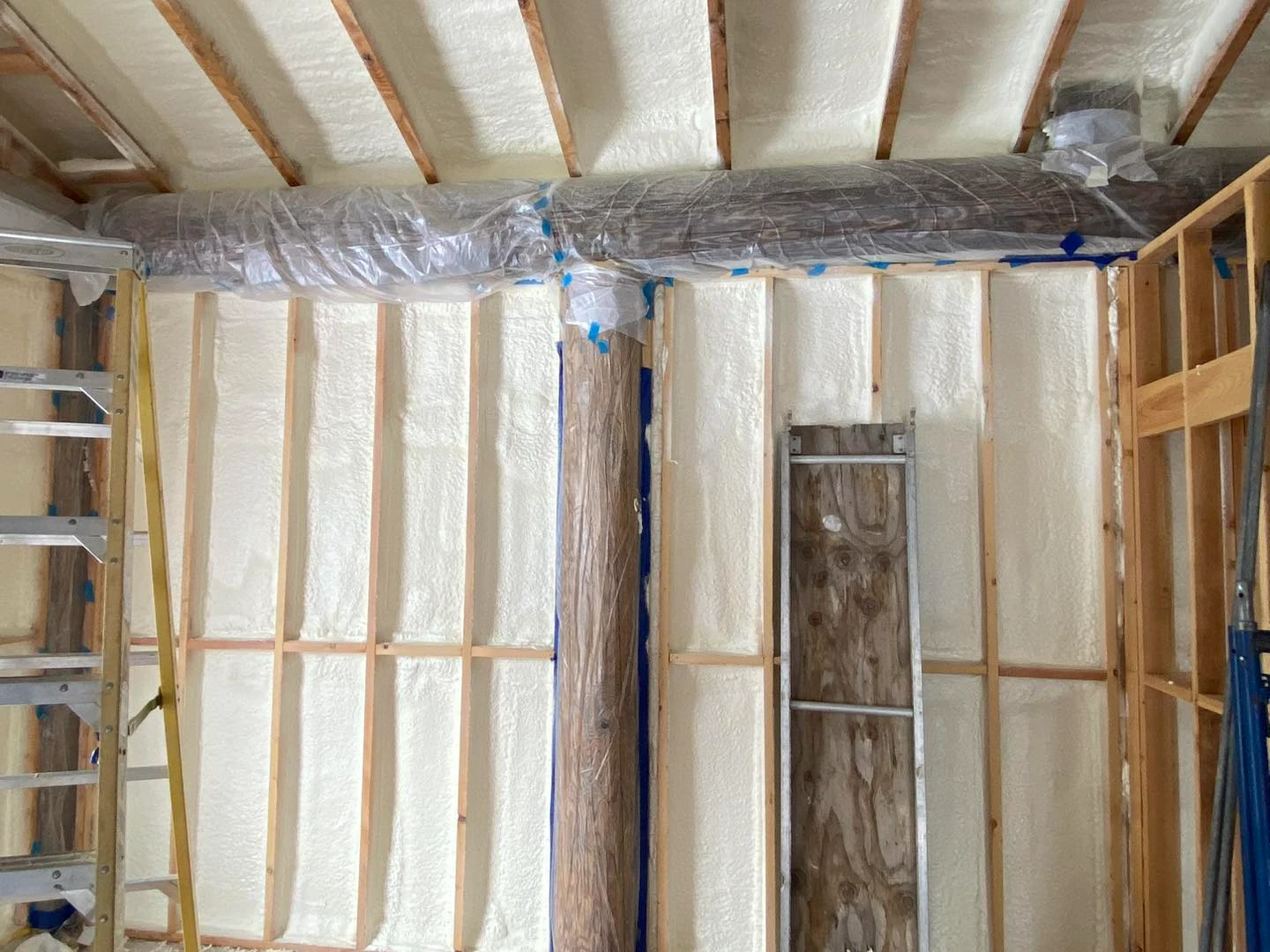
Alpine, Wyoming, sits in a heating-dominated climate zone where winter temperatures routinely plunge below zero and summer days can still push into the 90s. For homeowners here, the right spray foam insulation choice depends on two interconnected factors: your home’s structural characteristics and the specific performance demands of Zone 5B weather. Open-cell and closed-cell foams each serve distinct purposes, and applying the wrong type to the wrong area can lead to moisture problems, inadequate R-values, and wasted money. Understanding how climate data, building code requirements, and your home’s construction materials interact is the starting point for making a smart spray foam solution decision that performs year-round.
Alpine sits in Lincoln County in western Wyoming, classified under IECC Climate Zone 5B, a cool and dry region where heating loads dominate the energy profile of virtually every home. According to AutoHVAC.ai climate data, winter design temperatures in this region reach as low as -7°F, while summer peaks can hit 91°F. That 98-degree temperature swing places extraordinary demands on a building envelope, and the insulation layer is the primary defense against both extremes.
The “B” designation means the region is dry, which has a specific implication for insulation selection. Dry climates reduce but do not eliminate condensation risk. When warm indoor air meets cold exterior surfaces during Alpine’s long winters, moisture can accumulate inside wall cavities and attic spaces. This is where the vapor barrier properties of different foam types become a critical selection factor, not just an afterthought.
The Department of Energy’s Building America program categorizes this same region within a cold climate band where above-code insulation strategies are strongly recommended for any home seeking meaningful energy savings. For Alpine homeowners, this means code-minimum insulation may not deliver the comfort or efficiency results most people expect from a substantial investment.
Not all spray foam insulation performs the same way, and the distinction between open-cell and closed-cell products has major consequences in a Zone 5B climate.
Closed-cell spray foam is dense, rigid, and water-resistant. It delivers approximately R-6 to R-7 per inch of thickness and also functions as a vapor retarder and structural enhancer. This makes it particularly well-suited for below-grade applications like basement walls and crawl spaces, rim joists, and exterior-facing walls where both thermal resistance and moisture control are essential.
Open-cell spray foam is lighter, less expensive, and more flexible. It provides roughly R-3.6 to R-3.7 per inch. It air-seals effectively but does not serve as a vapor barrier, meaning it requires a separate vapor retarder in cold climates to prevent condensation issues. It excels in interior applications such as wall cavities and attic floor spray, where the lower cost per board foot can cover larger areas within a budget.
| Property | Closed-Cell Spray Foam | Open-Cell Spray Foam |
|---|---|---|
| R-Value per Inch | R-6 to R-7 | R-3.6 to R-3.7 |
| Density | ~2.0 lb/ft³ | ~0.5 lb/ft³ |
| Vapor Barrier | Yes (Class II) | No |
| Water Resistance | High | Low (absorbs water) |
| Best Applications | Basements, crawl spaces, rim joists, exterior walls | Interior wall cavities, attics, sound-dampening |
| Cost per Board Foot | Higher | Lower |
| Structural Reinforcement | Yes | No |
According to the U.S. Department of Energy’s Building America guide, closed-cell foam at R-6 per inch and open-cell foam at approximately R-3.6 per inch represent the standard benchmarks for residential applications. In Alpine’s climate, the thickness required to meet code and achieve comfort targets differs significantly between the two products.
The right foam choice also depends heavily on how your home is built. Alpine features a mix of construction types, and each presents different insulation challenges.
For conventional framed homes with 2×4 or 2×6 walls, closed-cell spray foam applied at 2 to 3 inches in wall cavities meets or exceeds the Energy Star recommendation of R-15 insulative wall sheathing for zones 5 through 8. For 2×4 walls, where cavity depth is limited to about 3.5 inches, closed-cell is often the only spray foam option that reaches the target R-value without furring out the walls. Open-cell foam in a 2×4 cavity would only deliver approximately R-13, which technically meets the minimum but leaves less margin for error, making overall spray foam performance a critical factor in insulation planning.
Log homes are common in the Alpine area, and they present a unique insulation challenge. Solid log walls have inherent thermal mass but also significant air infiltration through the natural settling and checking of logs. Spray foam is not typically applied directly to the interior of exposed log walls, but closed-cell foam is highly effective for sealing the joints, gaps, and chinking interfaces. For timber frame homes with structural insulated panels (SIPs) or insulated roof systems, closed-cell foam can supplement the existing insulation in critical junction points like eave lines and valleys.
Alpine’s frost depth and cold soils make below-grade insulation especially important. Closed-cell spray foam is the clear choice for basement walls and crawl space ceilings in this climate zone. It provides the necessary R-value in a thinner application, resists moisture from the soil, and acts as a vapor barrier to prevent ground moisture from entering the living space. Open-cell foam should generally be avoided in below-grade applications in Zone 5B because it can absorb and retain water if exposed.
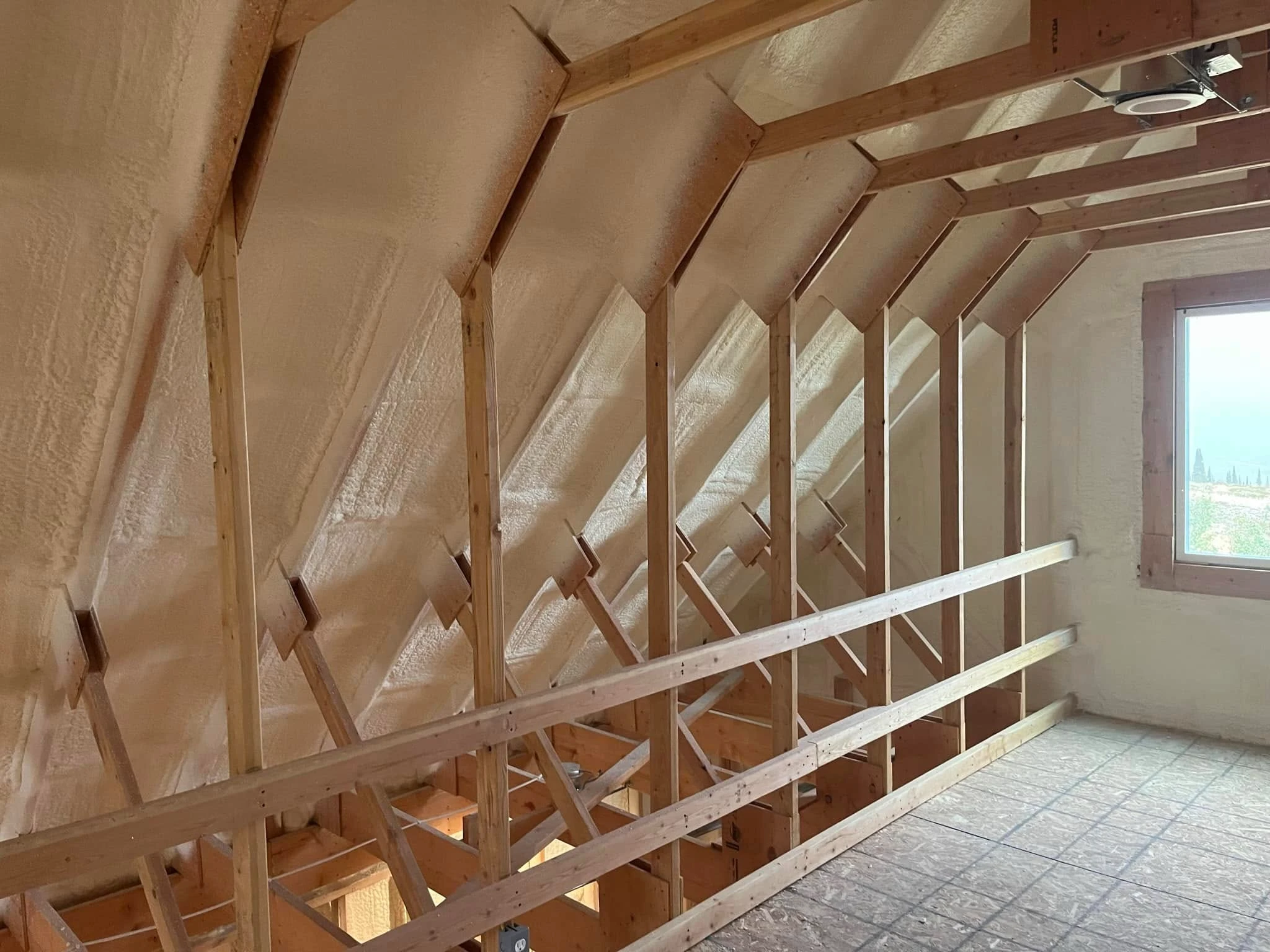
Attic insulation strategy in Alpine depends on whether the attic is conditioned (vented or unvented) or unconditioned. For conditioned cathedral ceilings and unvented attics, closed-cell spray foam applied directly to the roof deck provides both insulation and an air barrier at the plane of the roof. For vented attics with blown-in insulation on the floor, open-cell foam can be used to seal the attic floor penetrations and top plates, with bulk insulation layered above.
| Home Structure Element | Recommended Foam Type | Why |
|---|---|---|
| 2×4 framed walls | Closed-cell | Reaches R-21+ in limited cavity depth |
| 2×6 framed walls | Closed-cell or open-cell (with vapor retarder) | Cavity depth allows either option to meet R-20+ |
| Basement walls | Closed-cell | Moisture resistance and vapor barrier needed |
| Rim joists | Closed-cell | Seals air leakage and provides high R-value per inch |
| Crawl space ceiling | Closed-cell | Prevents moisture and air infiltration from below |
| Attic floor (vented attic) | Open-cell for sealing, bulk insulation above | Cost-effective air sealing at penetrations |
| Cathedral ceiling / unvented attic | Closed-cell on roof deck | Complete air and vapor barrier at roof plane |
| Log wall joints and gaps | Closed-cell | Fills irregular spaces and resists moisture |
Wyoming has adopted the IECC building energy code with specific requirements for insulation R-values and air tightness. According to the Insulation Institute’s Wyoming compliance guide, homes in Zone 5B must meet defined R-values for walls, ceilings, basements, and crawl spaces, and must also pass a blower door test at either 3 or 5 air changes per hour, depending on the compliance path chosen.
Spray foam insulation helps on both fronts. The air-sealing quality of both foam types significantly reduces air changes per hour, often making the difference between passing and failing a blower door test. Closed-cell foam’s higher R-value per inch helps meet prescriptive R-value requirements in thinner assemblies where traditional insulation would fall short.
For homeowners pursuing above-code performance, which the Energy Star recommends for zones 5 through 8, spray foam allows the building envelope to exceed minimums without requiring thicker walls or deeper cavities.
Closed-cell spray foam typically costs two to three times more per board foot than open-cell foam. However, in a heating-dominated climate like Alpine, the higher R-value per inch can mean that closed-cell achieves the required performance in half the thickness. The net cost difference is often smaller than the per-board-foot pricing suggests.
Beyond raw material cost, spray foam insulation delivers long-term savings through reduced heating fuel consumption. Alpine homeowners heating with propane, heating oil, or electric resistance systems stand to save the most, as these fuel sources carry the highest per-BTU cost. The Department of Energy estimates that air sealing and insulating can reduce heating and cooling costs by an average of 15% nationally, with higher savings likely in extreme cold climates where the heating season extends for six months or more.
| Homeowner Profile | Recommended Approach | Key Notes |
|---|---|---|
| New construction, standard framed | Closed-cell in walls and rim joists, open-cell in attic floor | Maximizes code compliance and air sealing |
| Remodeling older 2×4 home | Closed-cell in all wall cavities | Only way to reach adequate R-value in 3.5-inch depth |
| Log home owner | Closed-cell for joint sealing, supplemental foam in roof assembly | Focus on air infiltration first |
| Budget-conscious retrofit | Open-cell in accessible attics and walls, closed-cell only at rim joists and basement | Prioritize the biggest leakage and heat loss areas |
| High-performance or net-zero target | Closed-cell throughout envelope, continuous exterior insulation supplement | Achieves above-code performance and minimal thermal bridging |
Choosing the right installer in a small town like Alpine matters as much as choosing the right product. A qualified spray foam contractor should walk through your home, identify specific air leakage pathways, explain why they are recommending one foam type over another for each area, and reference local climate zone requirements. They should carry current manufacturer certifications and carry insurance that specifically covers spray foam application. Pricing should be broken down by area and foam type rather than presented as a single lump sum. If a contractor recommends the same foam product for every surface without discussion, that is a sign to get a second opinion.
The most frequent error homeowners make in cold climates is installing open-cell spray foam in contact with cold surfaces without a proper vapor retarder. In Alpine, this can drive moisture into wall cavities during winter, leading to mold growth and wood rot behind the drywall, a risk detailed in the Building Science Corporation’s Residential Foam Guide. Another common mistake is under-insulating rim joists, which are among the highest air leakage points in any home. Finally, venting a crawl space that has been insulated with foam at the floor above creates a conflict, since the crawl space should either be conditioned and sealed or left uninsulated at the floor with insulation on the foundation walls.
At High Country Solutions, we understand the specific demands of building and insulating homes in Lincoln County’s extreme cold climate. Our team evaluates your home’s structure, identifies priority areas for air sealing and insulation, and recommends the right spray foam type for each building zone. Whether you are building new, retrofitting an older home, or addressing comfort problems in your current space, we provide honest assessments and code-compliant installations tailored to Alpine’s conditions.
Call us at (307) 248-9063 or email [email protected] to discuss your project.
No, open-cell spray foam should not be used in below-grade or basement applications in Zone 5B. Open-cell foam can absorb and retain water if exposed to soil moisture, and it does not provide a vapor barrier. Closed-cell spray foam is the appropriate choice for basement walls and crawl spaces in Alpine’s climate.
For 2×4 framed walls, a full cavity fill of approximately 3.5 inches of closed-cell foam delivers roughly R-21 to R-24, which exceeds the Energy Star recommendation of R-15 to R-19 for zones 5 through 8. For 2×6 walls, 3 to 4 inches of closed-cell foam will achieve R-18 to R-28, depending on the specific product used.
In a heating-dominated climate where winter temperatures reach -7°F, spray foam insulation delivers strong value through both high R-value per inch and superior air sealing. Homes heated with propane or electric resistance systems benefit most, as reduced air leakage directly translates to lower fuel costs over a heating season that can last six months or longer.
Spray foam is highly effective for log homes when used strategically to seal joints, gaps, and intersections where air infiltration is highest. Closed-cell foam should be applied at log-to-log interfaces, around windows and doors, and at roof-to-wall transitions. It is not typically applied over exposed interior log surfaces.
The simplest way to verify compliance is through a blower door test, which measures air changes per hour. Wyoming’s energy code requires either 3 or 5 ACH, depending on the compliance path. A certified energy auditor or insulation contractor can perform this test and evaluate whether your existing insulation R-values meet the prescriptive requirements for Climate Zone 5B.